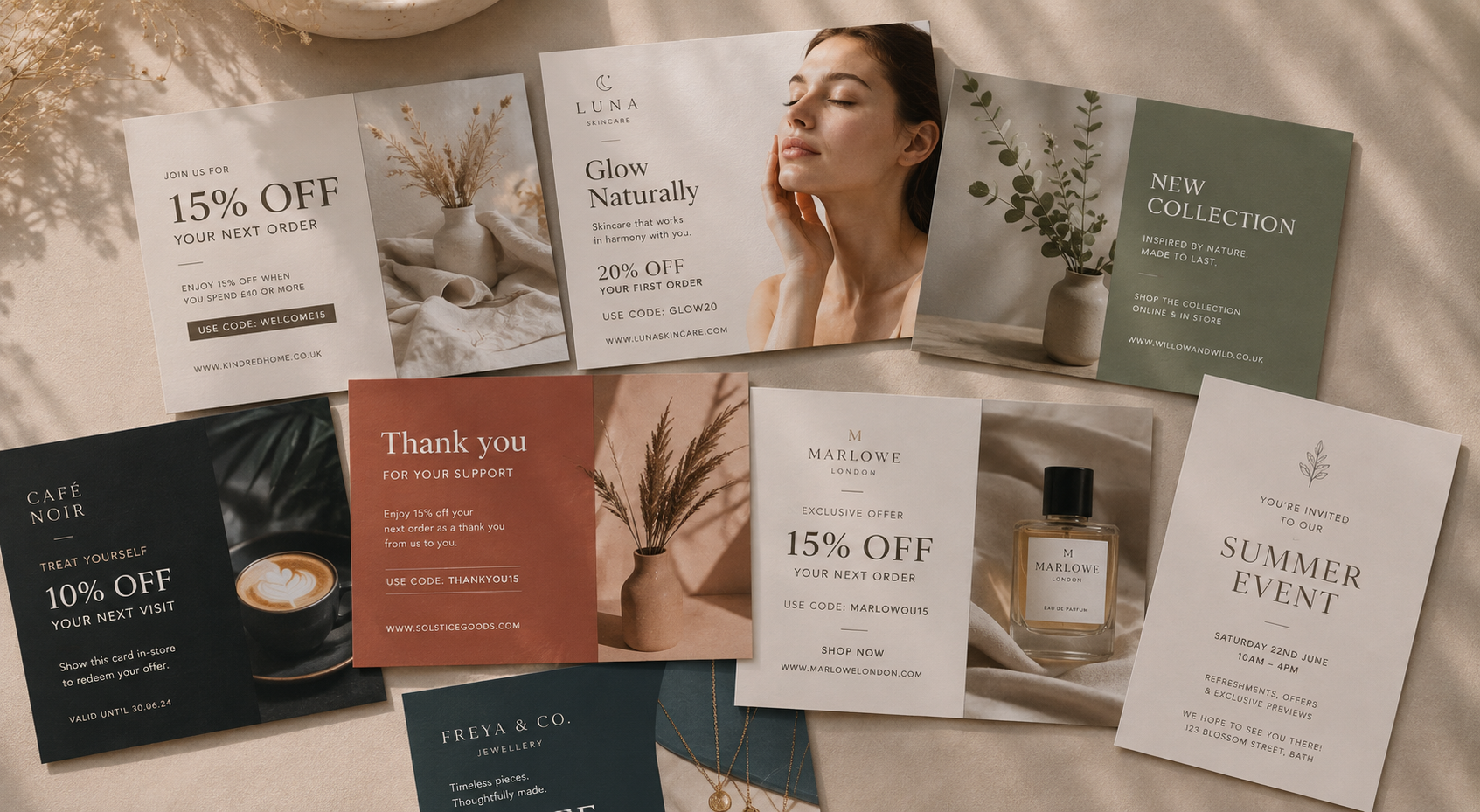
Everything you need to know about planning, designing, printing, personalising and delivering an effective postcard marketing campaign.
Postcards are one of the simplest forms of direct mail, but that doesn't mean they have to be basic. A well-designed postcard can put a promotion directly into a customer's hands, introduce a new product, drive traffic to a website, encourage a previous customer to return or help a local business reach a specific area.
Unlike an email, a postcard doesn't sit in an inbox competing with dozens of other messages. It arrives physically, can be seen immediately and gives businesses an opportunity to make an impression through design, imagery, messaging and physical print quality.
But successful postcard marketing requires more than printing an offer and putting it in the post. Audience targeting, data quality, design, format, personalisation, printing, postage and measurement all play a role. This guide covers everything you need to know to plan and deliver a postcard marketing campaign.
In this guide
01 What is postcard marketing?
02 Why use postcards for marketing?
03 What can postcards be used for?
04 Choosing your postcard format and size
05 How to design an effective marketing postcard
06 What should you put on a postcard?
07 Personalising postcard campaigns
08 Postcard printing: paper, finishes and production
09 Postcard mailing and postage
10 How to plan a postcard campaign
11 Postcard marketing ideas and examples
12 Combining postcards with digital marketing
13 How to measure postcard marketing
14 How much does postcard marketing cost?
15 Postcard campaign checklist
16 Frequently asked questions
1. What is postcard marketing?
Postcard marketing is a form of direct mail that uses printed postcards to communicate a promotional, informational or brand message directly to a targeted audience. Unlike a traditional mailshot, postcards don't require an envelope, meaning the recipient can see the message as soon as they receive it.
A postcard can be used to communicate a relatively simple message, such as: 20% off your next purchase. Or it can introduce a new product, promote an event, showcase a service or direct the recipient to a website.
Postcards can also be highly targeted. Businesses can send different postcards to different customer groups, geographic areas or segments of their mailing database.
Common postcard marketing campaigns include:
- Promotional offers
- New product launches
- Seasonal campaigns
- Event invitations
- Store openings
- Customer reactivation
- Loyalty campaigns
- Local marketing
- Brand awareness
- Product launches
- Appointment reminders
- Fundraising campaigns
- Service promotions
Postcard marketing vs traditional mailshots
The biggest difference is the format. A traditional mailshot may contain a letter, envelope and additional inserts, while a postcard delivers the message directly on the printed piece.
| Postcard | Mailshot | |
|---|---|---|
| Envelope required | No | Usually |
| Message visible immediately | Yes | No |
| Amount of content | Limited | More flexible |
| Production | Relatively simple | Can be more complex |
| Ideal for | Concise campaigns | Detailed messaging |
| Inserts | Limited | Can include multiple items |
Neither format is universally better. The right choice depends on what you want your campaign to achieve.
2. Why use postcards for marketing?
Postcards have several characteristics that make them useful for direct marketing.
They're immediately visible
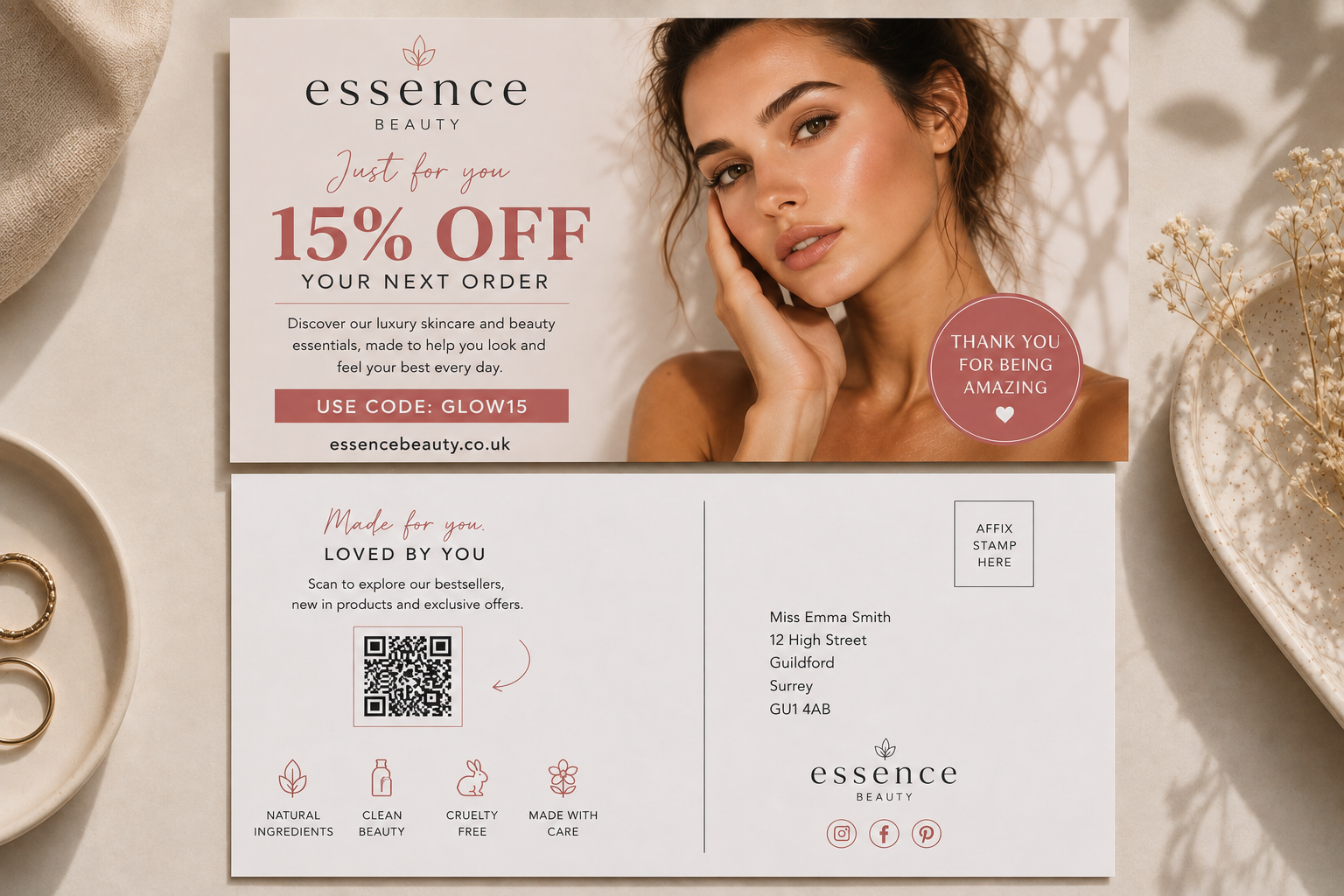
With an envelope, the recipient needs to open the communication before they see the message. A postcard, however, removes that extra step. The design, headline, offer and imagery can all be visible as soon as the postcard is picked up, which makes the first impression particularly important.
They're simple to understand
A postcard encourages marketers to focus on one clear message. There's limited space, so there's less temptation to fill the piece with lengthy copy.
A strong postcard might communicate:
What you're offering
↓
Why it matters
↓
What the recipient should do next
They can be highly targeted
Postcards can be sent to carefully selected audiences rather than distributed indiscriminately. For example, a retailer could target:
- Customers within a specific postcode
- Customers who haven't purchased recently
- Customers who bought a particular product
- High-value customers
- New customers
This makes the quality of the mailing data particularly important.
They're easy to integrate with digital campaigns
A postcard doesn't have to be the end of the customer journey. QR codes, campaign-specific URLs and promotional codes can take recipients from the physical postcard to a digital experience.
For example:
Postcard
↓
QR code
↓
Landing page
↓
Offer
↓
Purchase
They offer physical brand presence
A postcard gives a business a physical presence in the customer's home or workplace. Paper stock, photography, colour, typography and finishing can all contribute to how the brand is perceived. For premium brands, for example, a high-quality printed postcard can become part of the overall brand experience rather than simply carrying an advertisement.
3. What can postcards be used for?
There's no single type of business or campaign that postcards are suitable for. The format works particularly well when the message can be communicated clearly and the recipient has a straightforward action to take.
Promotional campaigns
Postcards can promote:
- Discounts
- Sales
- Special offers
- Limited-time promotions
- Seasonal campaigns
- Loyalty rewards
Example:
20% OFF YOUR NEXT ORDER
Scan the QR code to redeem.
New product launches
A postcard can provide a simple introduction to a new product or collection. The postcard might feature:
- A large product image
- A short description
- Key benefits
- Launch date
- Website or QR code
Customer reactivation
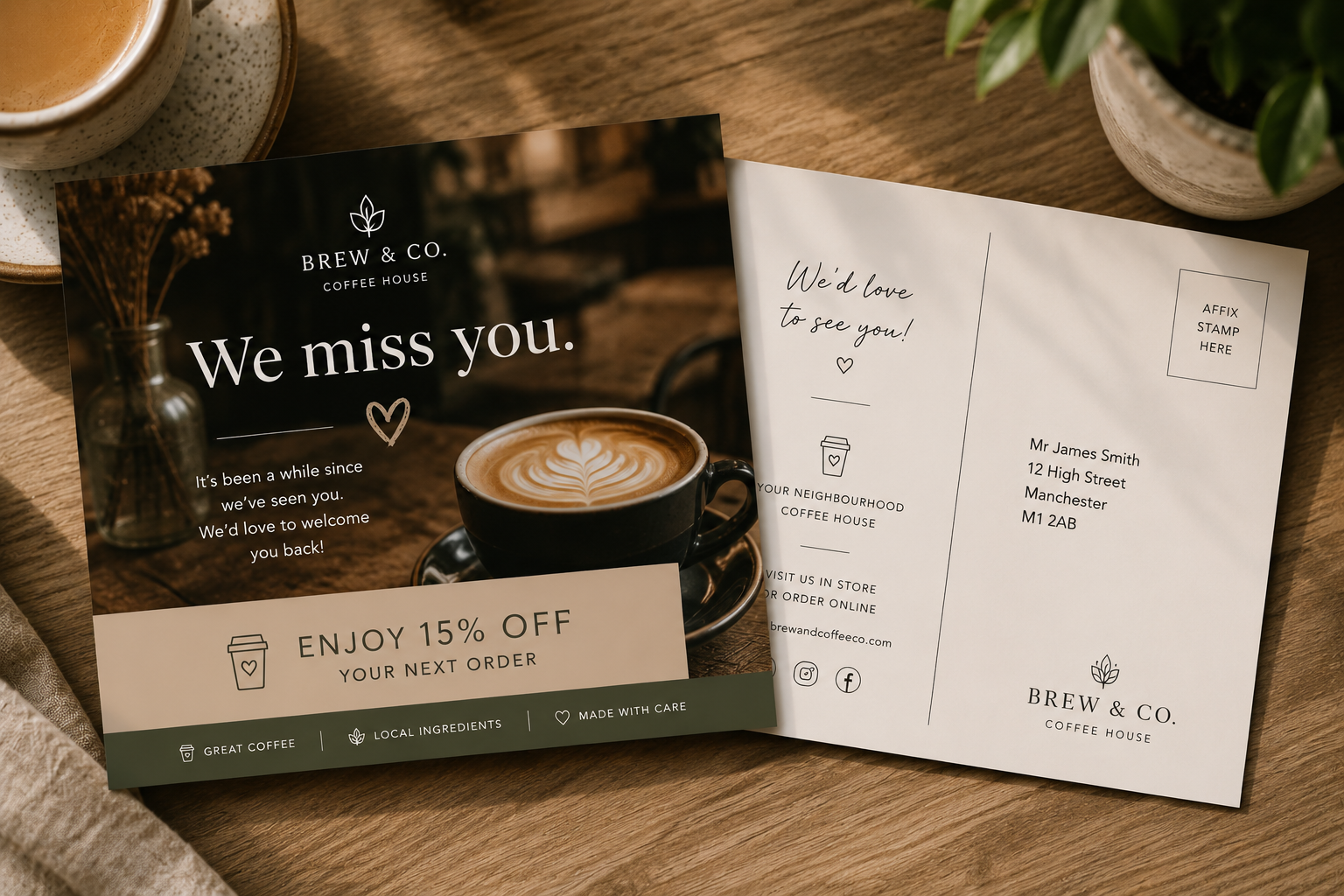
Postcards can be used to reconnect with customers who haven't purchased recently. For example:
We haven't seen you for a while...
followed by a relevant incentive to return.
This can be particularly effective when the messaging is based on customer data rather than sent to an entire database.
Local marketing
Postcards are particularly useful for businesses targeting a defined geographic area. Potential users include:
- Restaurants
- Retailers
- Estate agents
- Gyms
- Beauty businesses
- Hospitality businesses
- Local services
A campaign can be targeted to specific postcodes or areas depending on the available data and mailing strategy.
Events
Postcards can promote:
- Open days
- Exhibitions
- Product launches
- Events
- Seasonal experiences
- Local activities
The design can focus on the event itself while providing a clear route to registration.
Brand awareness
Not every postcard campaign needs an immediate sales offer. A postcard can instead introduce a brand, showcase a new collection or communicate a particular brand message. This is particularly useful when the visual presentation is an important part of the communication.
4. Choosing your postcard format and size
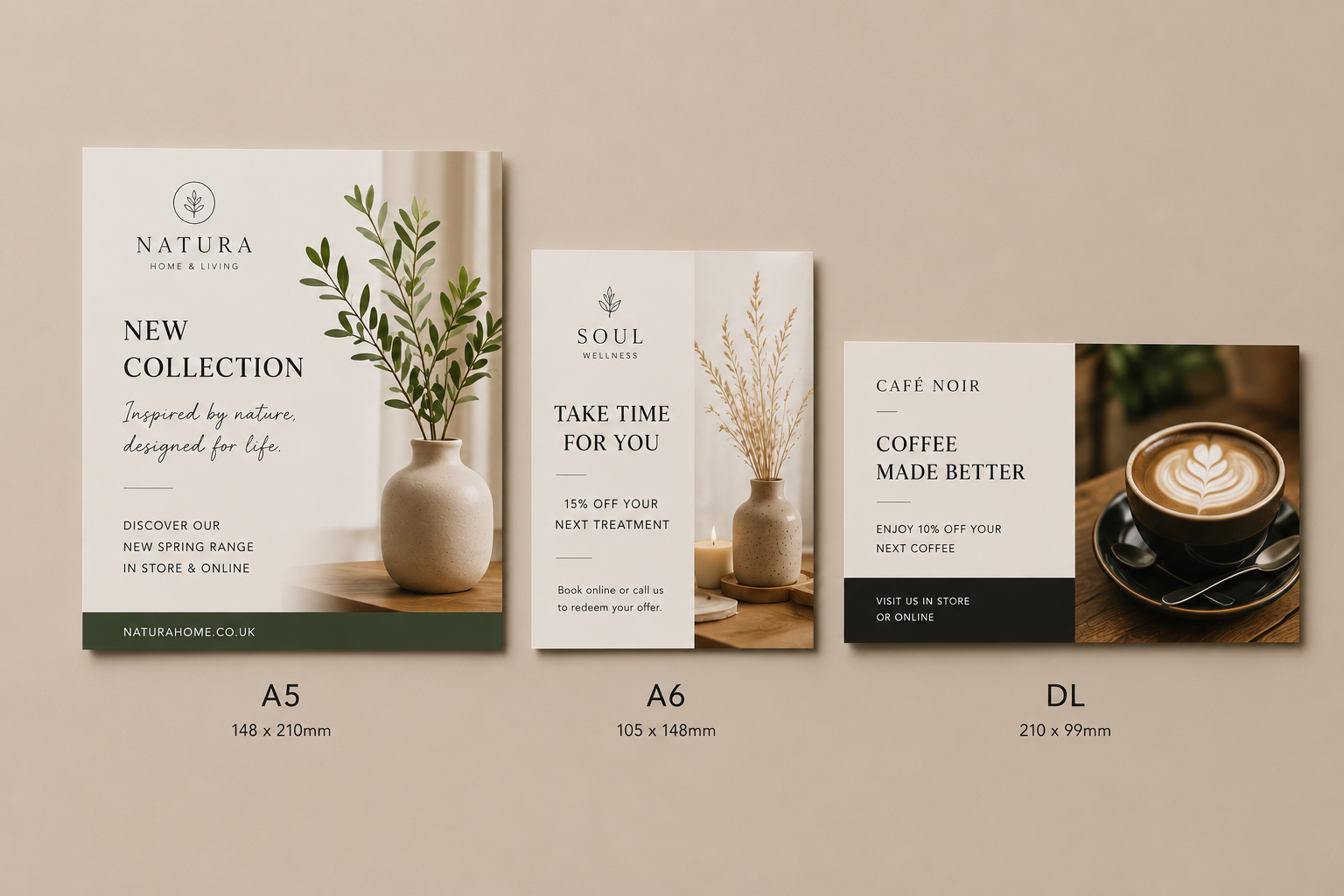
The physical dimensions of your postcard affect both its appearance and the amount of space available for your message. Common formats include A6, A5 and DL, although custom sizes may also be possible depending on the campaign.
A6 postcards
A6 is a compact format that works well when you need a straightforward message without requiring a large amount of space.
Good for:
- Offers
- Promotions
- Simple announcements
- Short campaigns
A5 postcards
A5 provides more space for imagery, copy and calls to action.
Good for:
- Product promotions
- Campaigns with more information
- Larger imagery
- More detailed offers
DL postcards
DL provides a narrow, elongated format that can work well for particular creative concepts.
Choosing the right size
Things to consider:
- How much information do you need to communicate?
If the answer is "very little", a smaller postcard may be appropriate. - How important is imagery?
A campaign built around a large photograph may benefit from more physical space. - What is the desired physical experience?
A premium or high-impact campaign may benefit from a larger format or a distinctive shape. - What are the postage implications?
Format, weight and mailing specifications can affect postage, so these should be considered before finalising the design. Take a look at our Bulk Postage Services for discounted postage rates.
5. How to design an effective marketing postcard
A postcard needs to communicate quickly, as the recipient may only look at it for a few seconds before deciding whether to keep reading, visit the website or put it aside. Good postcard design therefore prioritises clarity over complexity.
Start with one clear message
Don't try to communicate everything your business does. Instead, focus on one campaign objective. For example:
NEW COLLECTION
is clearer than trying to combine a new collection, loyalty programme, company history and five different offers on one postcard.
Use a strong headline
The headline is often one of the first things the recipient will notice.
It should communicate either:
- The benefit
- The offer
- The news
- The reason to act
Examples:
YOUR NEXT ADVENTURE STARTS HERE
20% OFF YOUR NEXT ORDER
MEET OUR NEW COLLECTION
NOW OPEN IN YOUR AREA
Make the benefit obvious
The recipient needs a reason to care. Don't make them work to understand what's being offered.
Use imagery strategically
A strong image can communicate more quickly than a large block of text.
- For product-led campaigns - the product itself may be the hero.
- For service businesses - photography can help establish the desired mood or outcome.
Keep the copy concise
Postcards aren't designed to carry lengthy explanations.
Use:
- Short sentences
- Short paragraphs
- Bullet points
- Clear headings
- Bold key information
If you need to communicate a significant amount of information, another direct mail format, like mailshots, may be more appropriate.
Make your call to action obvious
Every promotional postcard should ideally give the recipient a clear next step. Examples include:
SHOP NOW
BOOK TODAY
SCAN TO CLAIM YOUR OFFER
VISIT OUR WEBSITE
CALL US
FIND YOUR NEAREST STORE
The CTA should stand out visually from the surrounding copy.
6. What should you put on a postcard?
The exact content will depend on the purpose of the campaign, but most marketing postcards need several key elements.
Front
The front of the postcard is usually where you capture attention. It might contain:
- Main image
- Campaign headline
- Brand identity
- Short promotional message
Back
The reverse can contain:
- Supporting information
- Offer details
- Contact information
- Website address
- QR code
- Promotional code
- Terms and conditions
- Addressing information
The design should guide the recipient from the main message towards the desired action.
A simple postcard content formula
1. ATTENTION
A strong headline or image
↓
2. INTEREST
A clear benefit or offer
↓
3. ACTION
A prominent CTA
This simple structure can work across many types of campaigns.
7. Personalising postcard campaigns
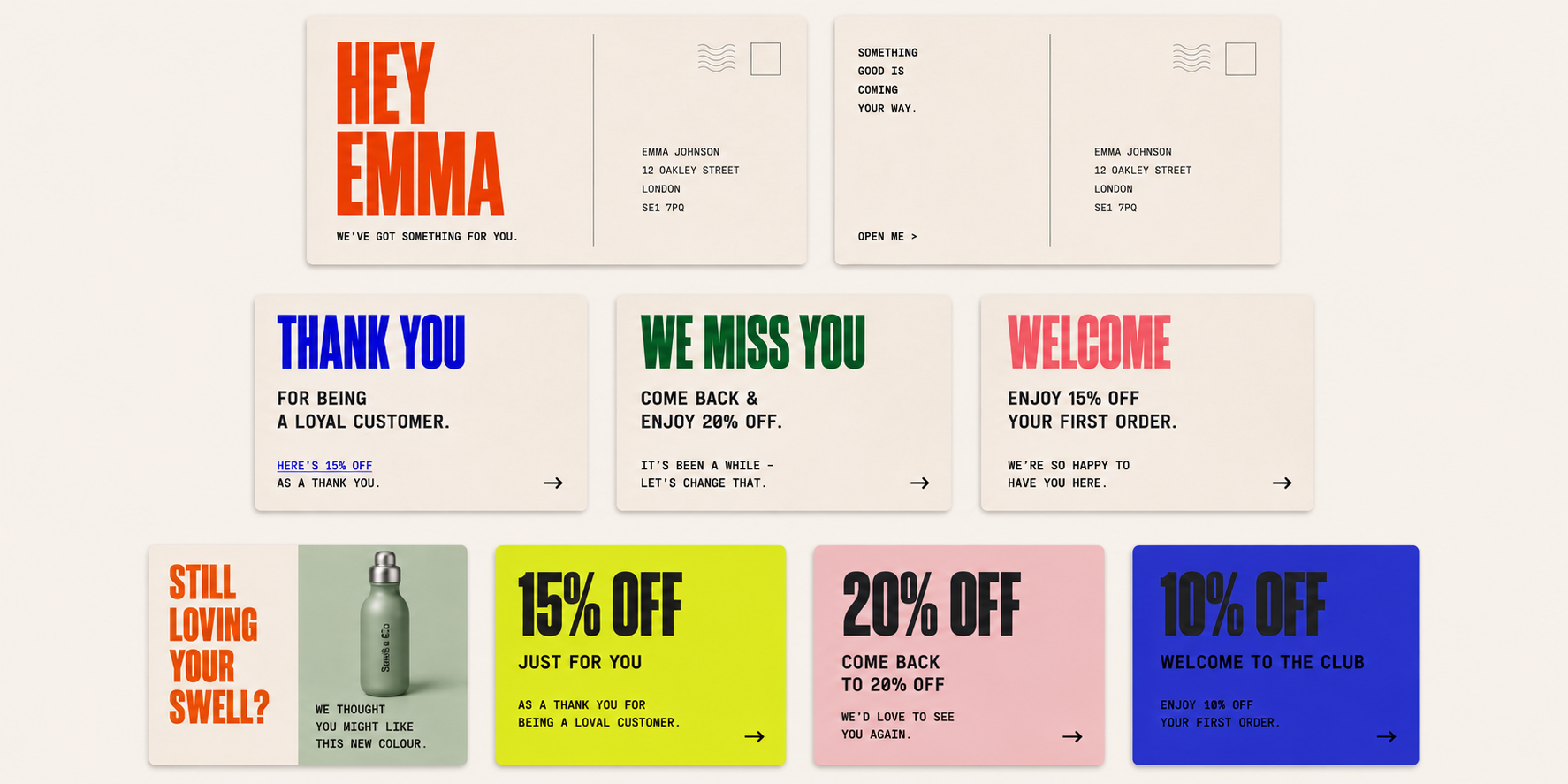
One of the biggest opportunities with postcard marketing is combining the simplicity of the format with customer data. Personalisation doesn't have to mean simply adding a first name.
Basic personalisation
Emma, we've got something for you.
Segmented personalisation
Different customer groups receive different versions of the postcard.
For example:
Existing customers → loyalty offer
Lapsed customers → reactivation offer
New customers → welcome message
Product personalisation
A recipient could receive imagery or messaging related to a product they've previously purchased.
Offer personalisation
Different customers could receive different incentives depending on their relationship with the business. This makes the postcard feel more relevant without necessarily making the design more complicated.
Find out more about our Personalised Direct Mail Services →
8. Postcard printing: paper, finishes and production
The physical quality of a postcard can affect how the recipient perceives the campaign. The right specification depends on the objective, design and budget.
Paper stock
Paper weight and finish can change how a postcard feels in the hand. A lighter stock may be appropriate for certain high-volume campaigns, while a heavier stock can provide a more substantial or premium feel.
Finish
Depending on the desired result, different finishes can be used to influence appearance and feel. Consider whether the campaign should feel:
- Premium
- Natural
- Colourful
- Minimal
- Luxurious
- Practical
- Bold
Colour & imagery
High-quality printing is particularly important for image-led postcard campaigns. Product photography, brand colours and detailed graphics need to reproduce clearly and consistently.
Variable data printing
Where postcards are personalised, variable data printing can allow individual pieces to contain different names, offers, images or other information.
Read more on choosing the right paper stock and finishes for your campaign >
9. Postcard mailing and postage
Once the postcards have been printed, they need to be prepared for distribution. Postage shouldn't be considered only after the design is finished.
The postcard's:
- Size
- Weight
- Quantity
- Format
- Addressing
- Mailing requirements
can all affect the distribution process.
Bulk postcard campaigns
Larger campaigns may benefit from bulk postage services and appropriate postal preparation. This can involve:
- Address preparation
- Data processing
- Sorting
- Postal preparation
- Dispatch
Think about postage before production
If you're planning a large campaign, discuss the postal requirements before finalising the postcard specification. A small change to format or weight could affect how the campaign is processed and posted.

10. How to plan a postcard marketing campaign
A successful postcard campaign starts long before the postcards reach the printer. Here's a simple campaign process.
Step 1: Define your objective
What do you want the postcard to achieve?
For example:
- Generate sales
- Drive website traffic
- Promote a new product
- Reactivate customers
- Generate enquiries
- Promote an event
Your objective will determine the message, audience and CTA.
Step 2: Define your audience
Decide exactly who should receive the postcard.
Consider:
- Existing customers
- Prospects
- Lapsed customers
- Location
- Purchase history
- Customer value
- Product interest
Step 3: Prepare your data
Before anything is printed, make sure the mailing data is accurate and ready.
Check for:
- Duplicates
- Incorrect addresses
- Outdated records
- Formatting issues
- Suppression requirements
Step 4: Choose your format
Decide:
- Size
- Orientation
- Single or double-sided design
- Paper stock
- Finish
- Quantity
Step 5: Create the creative
Develop:
Headline → Message → Imagery → Offer → CTA
Keep the campaign focused on one primary action.
Step 6: Consider personalisation
Ask whether customer data can make the campaign more relevant. This could be as simple as using a name or as sophisticated as changing offers and imagery by customer segment.
Learn how leveraging personalisation can improve ROI →
Step 7: Build in tracking
Decide how you'll measure responses. Options include:
- QR codes
- Dedicated landing pages
- Promotional codes
- Unique URLs
- Phone numbers
- Online forms
Step 8: Produce the postcards
Once the artwork and data are approved, the postcards can move into production.
Step 9: Prepare & post
The completed postcards are prepared for mailing and dispatched.
Discover how you can benefit from postage discount when working with us →
Step 10: Measure the results
Track the response against your original objective.
11. Postcard marketing ideas & examples
There are countless ways to use postcards, but the most effective ideas usually have a clear audience and a clear action.
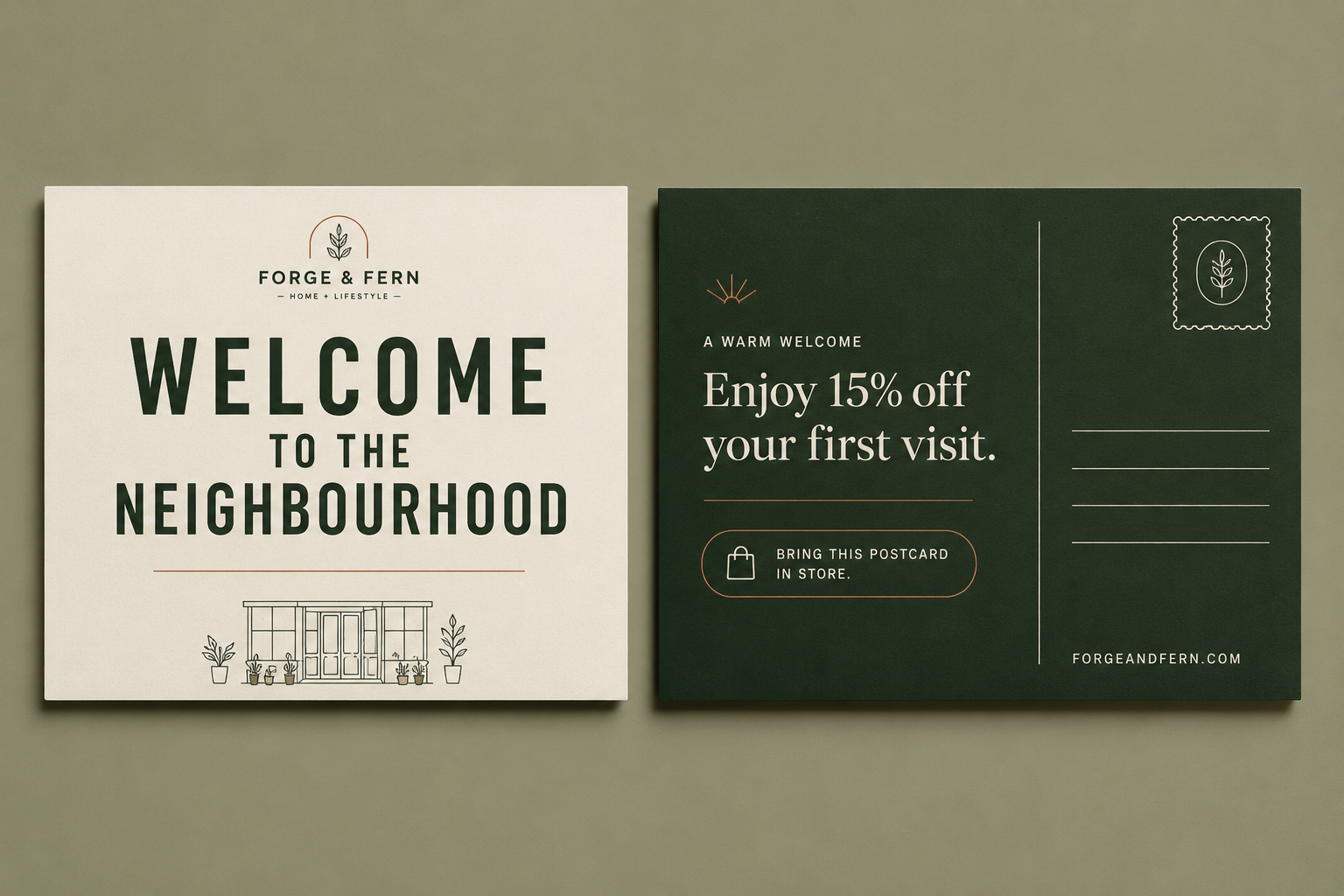
1. New customer offer
Front: WELCOME TO THE NEIGHBOURHOOD
Back: Enjoy 15% off your first visit.
CTA: Bring this postcard in store.
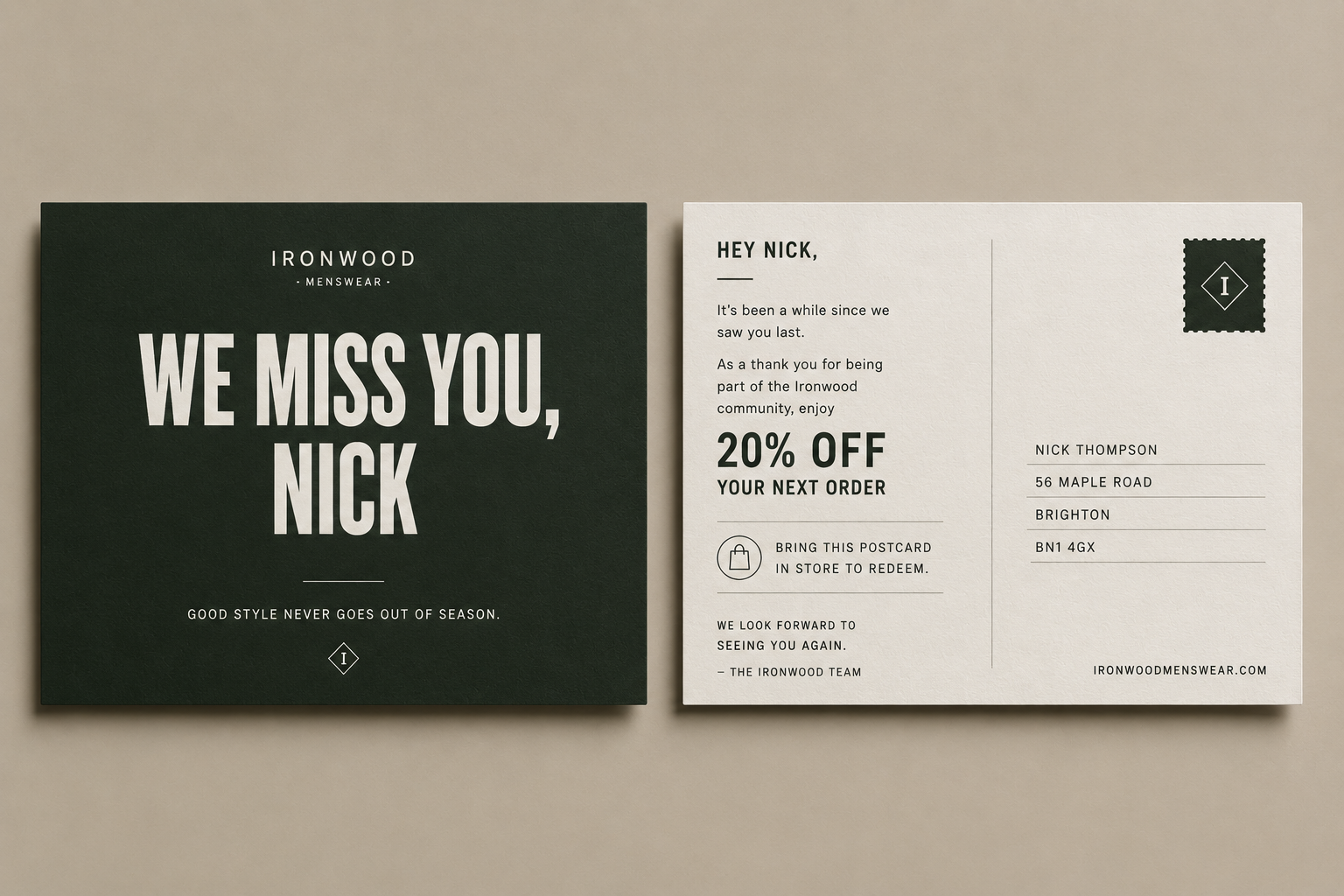
2. Customer reactivation
Front: WE MISS YOU
Followed by a personalised offer encouraging the customer to return.
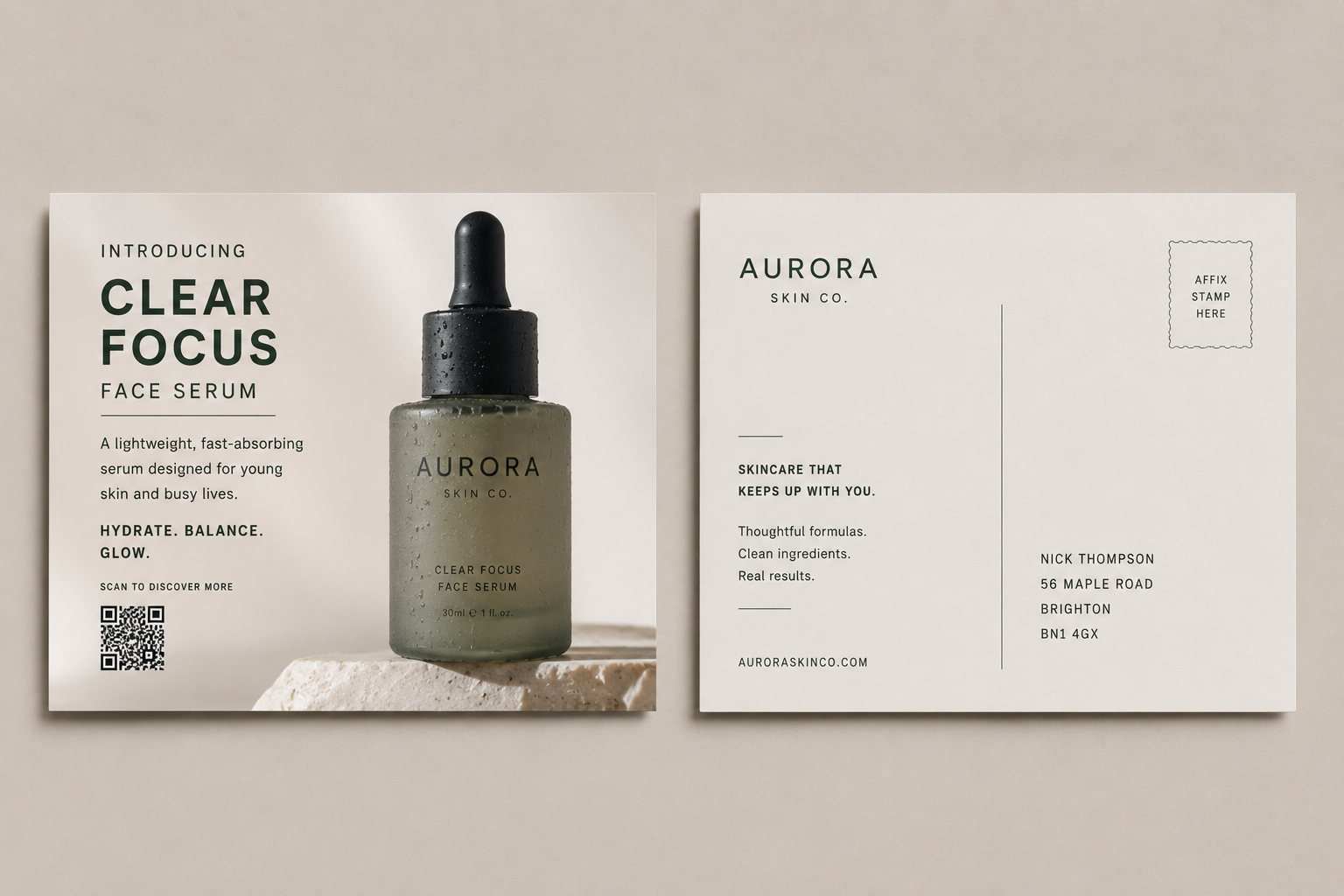
3. New product launch
Large product photography with:
INTRODUCING [PRODUCT]
Short description + QR code to discover more.
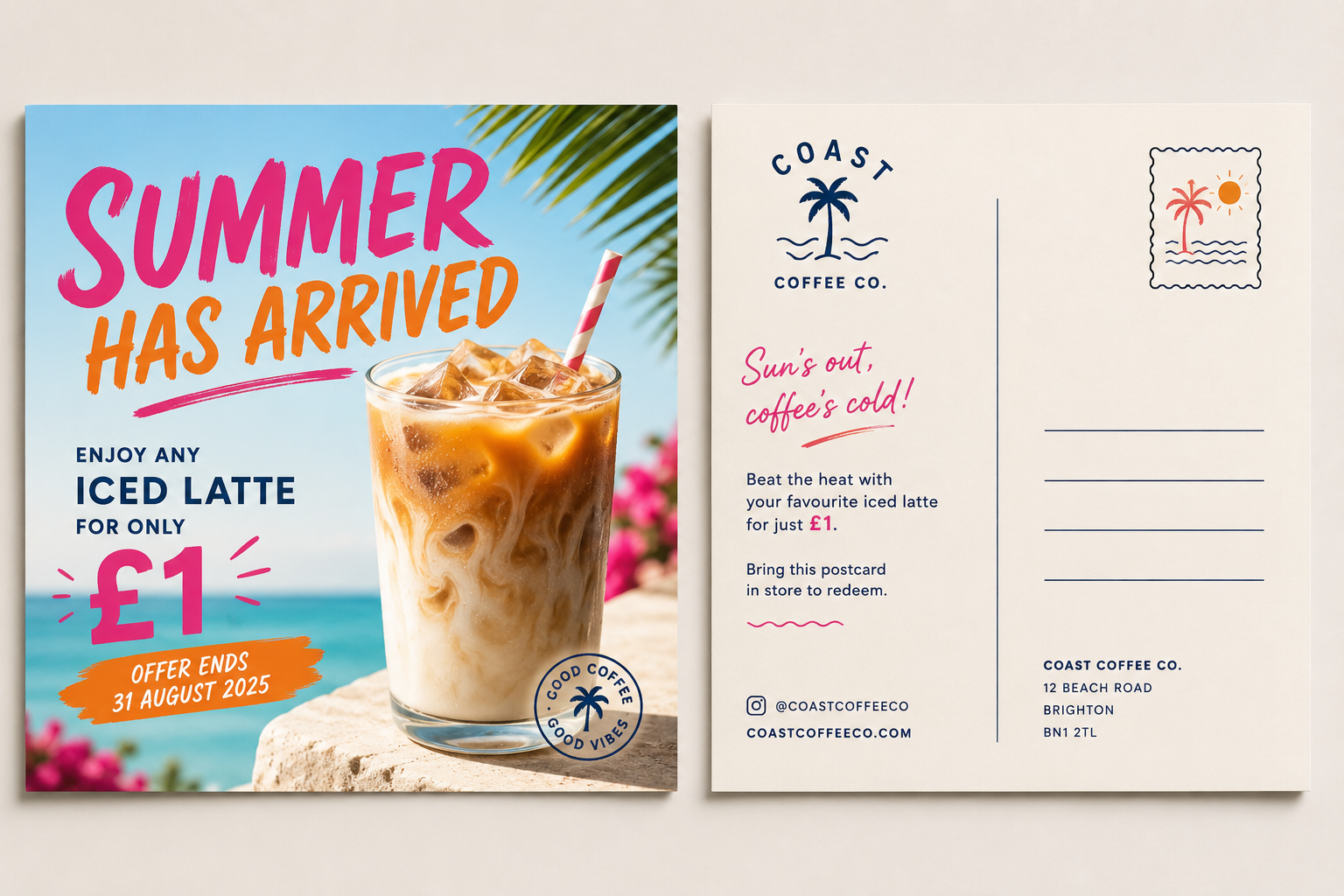
4. Seasonal promotion
For example:
SUMMER HAS ARRIVED
with a seasonal offer and clear expiry date.
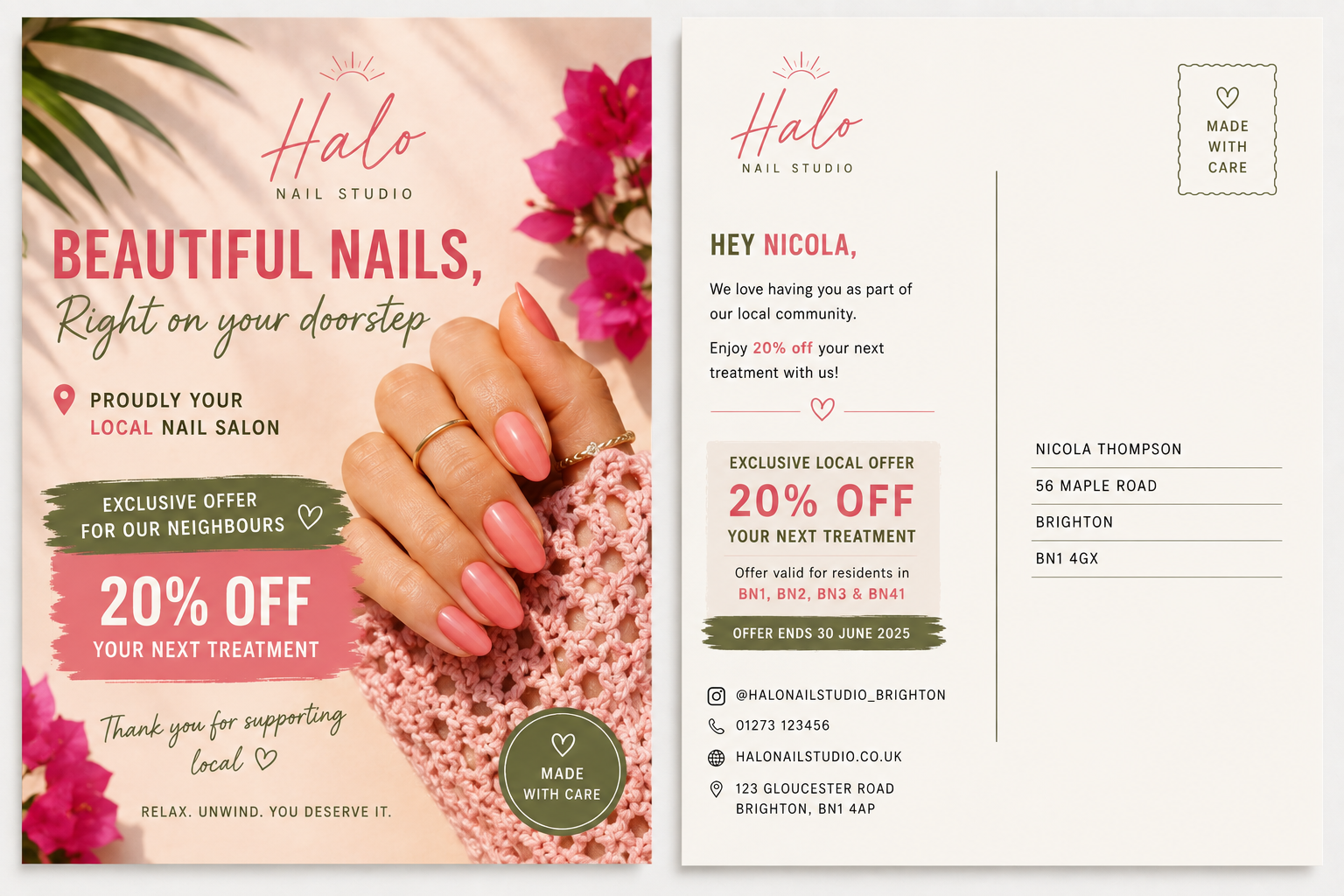
5. Local business campaign
Target specific postcodes with an offer relevant to people living nearby.
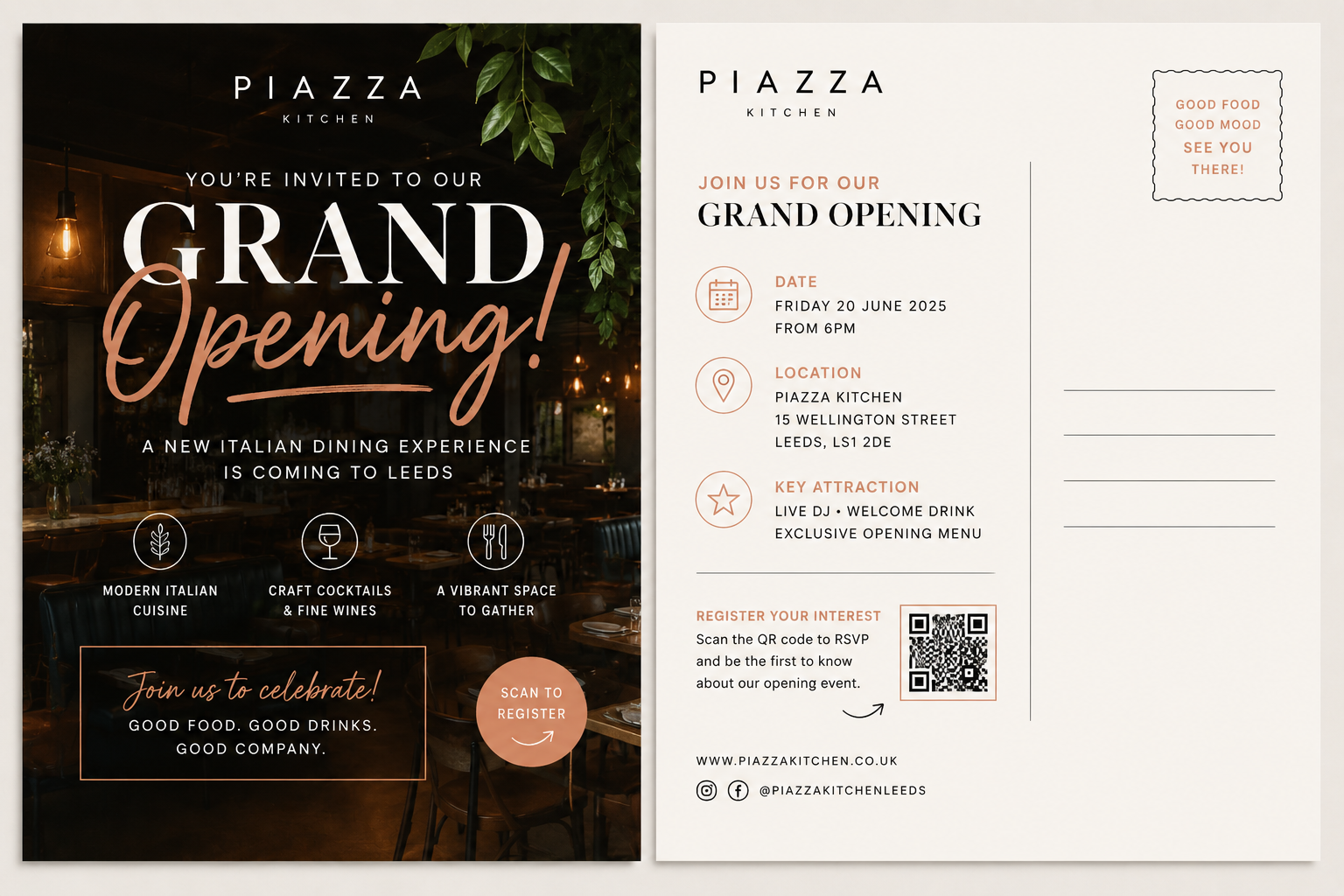
6. Event promotion
Use the postcard to communicate:
- Event date
- Location
- Key attraction
- Registration information
- QR code
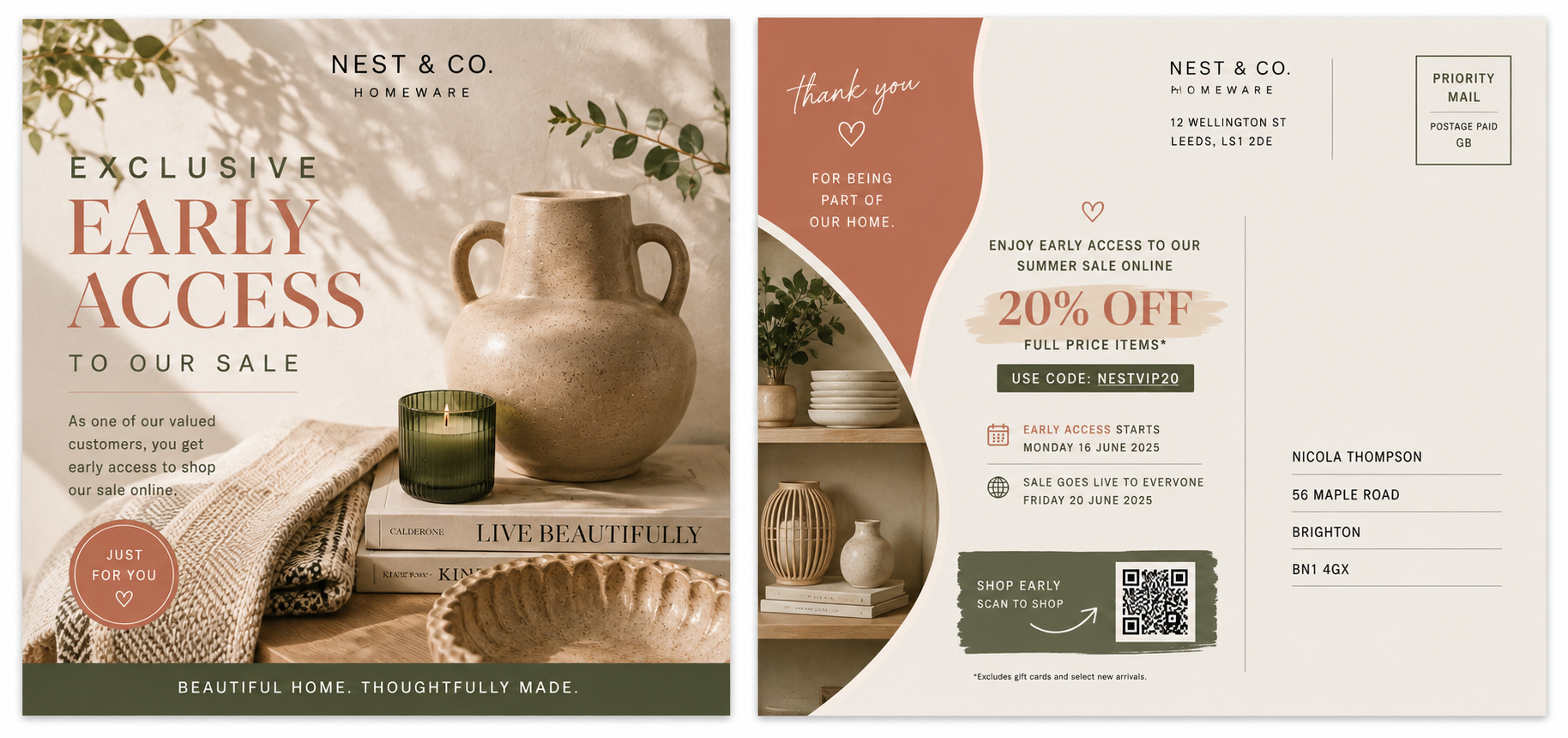
7. Customer loyalty
Send existing customers an exclusive offer or early access message.
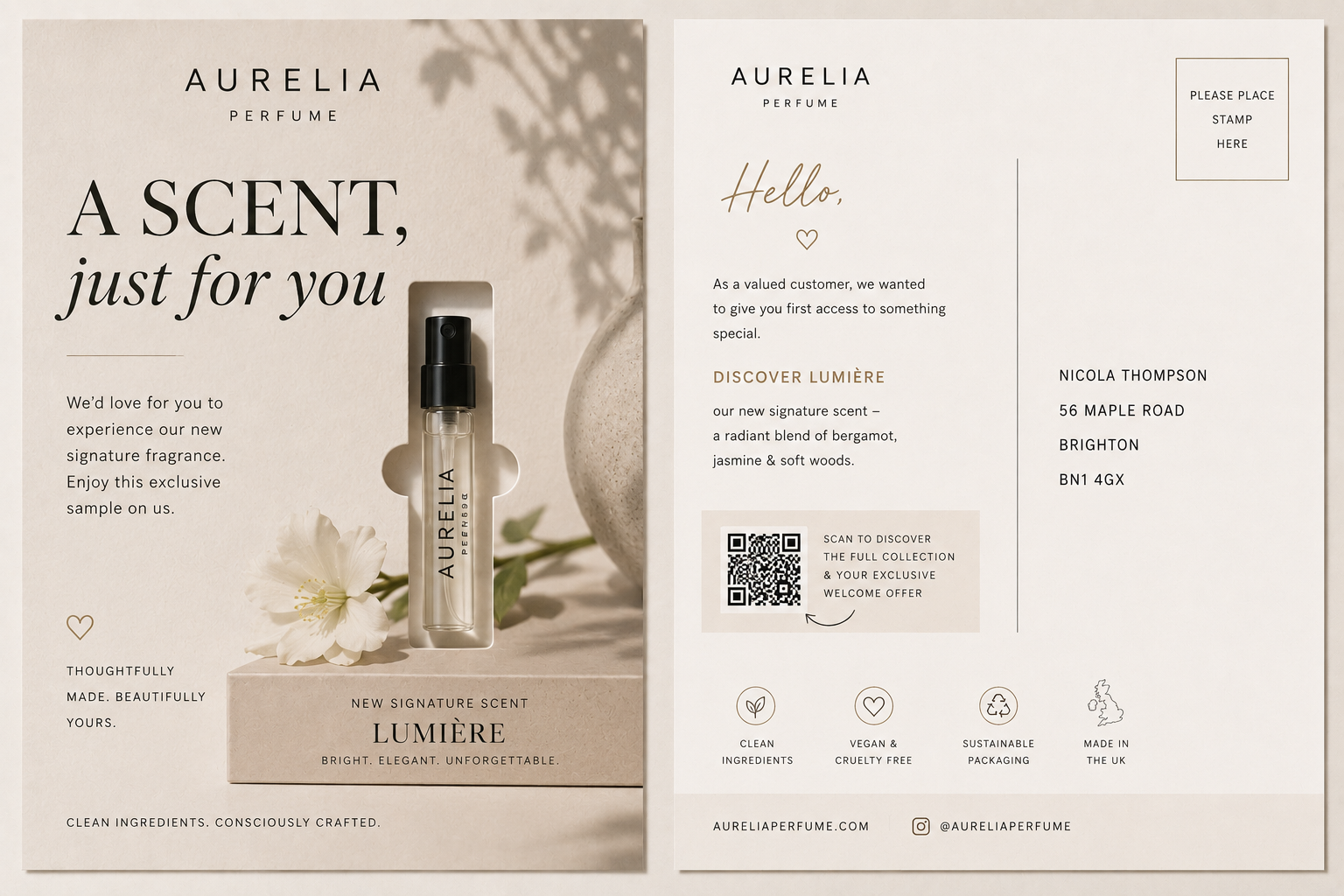
8. Product sampling
For products that can be physically included with a mailing, a postcard can form part of a larger promotional pack.
Take a look at all our product sampling services →
12. Combining postcards with digital marketing
A postcard doesn't have to send customers directly to your homepage... Give them a specific digital journey.
Example campaign
Personalised postcard
Emma, discover our new collection.
↓
QR code
↓
Dedicated landing page
↓
Product collection
↓
Purchase
This makes the physical campaign part of a wider marketing journey.
Ways to connect postcards & digital
QR codes
Direct recipients to a specific page.
Unique URLs
Use a memorable or campaign-specific URL.
Promotional codes
Measure purchases generated by the mailing.
Landing pages
Create a page specifically for postcard recipients.
Email follow-up
Where appropriate, follow up with recipients through digital channels.
Retargeting
Use the digital interaction as part of a wider customer journey where appropriate.
13. How to measure postcard marketing
A postcard campaign should have a measurable objective. The most appropriate metrics depend on what you're trying to achieve.
- Response rate - How many people responded to the campaign?
- Conversion rate - How many responses resulted in the desired action?
- Website visits - Did the postcard generate additional traffic?
- QR code scans - How many recipients scanned the code?
- Promotional code usage - How many customers used the campaign-specific code?
- Revenue - How much revenue was generated?
- Return on investment - How did the value generated compare with the total campaign cost?
Example measurement journey
10,000 postcards sent
↓
500 QR scans
↓
150 website purchases
↓
£X revenue
This allows the campaign to be assessed based on actual outcomes rather than simply how many postcards were delivered.
14. How much does postcard marketing cost?
There is no single price for a postcard campaign. The total cost depends on several factors.
- Quantity - Larger campaigns can change the cost per individual postcard and may affect postage options.
- Size - Different postcard formats require different amounts of material and may have different mailing implications.
- Paper stock - The chosen paper weight and finish affect production costs.
- Design - Artwork can be supplied by the customer or created as part of a wider campaign depending on requirements.
- Personalisation - Variable data and multiple versions can affect production complexity.
- Data processing - Cleaning, standardising and preparing a mailing database can form part of the overall campaign cost.
- Postage - For larger campaigns, postage can be a significant part of the overall budget.
- Fulfilment - Additional handling may be required depending on the campaign.
How to keep postcard campaign costs under control
Start with accurate data
Don't pay to print and post to records that shouldn't be included.
Choose the right format
More elaborate doesn't necessarily mean more effective.
Plan postage early
Understand the mailing requirements before finalising the format.
Consider volume
Larger campaigns may benefit from bulk postage arrangements.
Combine services
Using one supplier for data, production and postage can simplify campaign management.
15. Postcard campaign checklist
Use this checklist when planning your next campaign.
Strategy
☐ Define the campaign objective
☐ Identify your audience
☐ Decide the desired action
☐ Set a campaign budget
☐ Decide how results will be measured
Data
☐ Clean the mailing data
☐ Remove duplicates
☐ Check addresses
☐ Segment the audience
☐ Check relevant suppression/preferences
☐ Prepare personalisation fields
Creative
☐ Choose postcard size
☐ Choose orientation
☐ Create a strong headline
☐ Select imagery
☐ Write concise supporting copy
☐ Include the key benefit
☐ Add a clear CTA
☐ Add QR code/URL if required
☐ Include terms and conditions where relevant
Production
☐ Choose paper stock
☐ Choose finish
☐ Confirm quantities
☐ Check artwork
☐ Approve proof
☐ Confirm personalisation
Postage
☐ Confirm postcard specifications
☐ Check weight
☐ Prepare addressing data
☐ Confirm postal requirements
☐ Arrange sorting/preparation
☐ Schedule dispatch
Measurement
☐ Create tracking URLs
☐ Set up QR code tracking
☐ Create promotional codes
☐ Monitor responses
☐ Track conversions
☐ Calculate campaign ROI
Frequently Asked Questions
What size should a marketing postcard be?
Common postcard formats include A6, A5 and DL, although other sizes may be possible. The best size depends on the amount of content, desired visual impact and mailing requirements.
What should you put on a marketing postcard?
A postcard should generally include a clear headline, relevant imagery, a concise message, the key benefit and a prominent call to action. Depending on the campaign, it may also include a QR code, website, promotional code or contact details.
Can postcards be personalised?
Yes. Postcards can be personalised using names, offers, messages, product recommendations and other customer information.
Can postcards include QR codes?
Yes. QR codes can connect a physical postcard with a digital campaign, directing recipients to landing pages, offers, product pages, event registration pages or other online content.
How much does postcard marketing cost?
The cost depends on factors including quantity, postcard size, paper stock, printing, personalisation, data processing, fulfilment and postage.
Can I send postcards to a specific postcode?
Yes. Depending on the available mailing data and campaign requirements, postcards can be targeted geographically.
Can postcards be used for B2B marketing?
Yes. Postcards can be used to reach businesses and professional audiences, particularly for concise offers, event promotions, product launches and awareness campaigns.
How do I measure a postcard campaign?
Use trackable actions such as QR codes, dedicated URLs, promotional codes, landing pages, enquiry forms or campaign-specific contact details. These can then be measured against the number of postcards sent.
Can a mailing house manage the whole postcard campaign?
Yes. A mailing house can manage multiple stages of a campaign, including data preparation, printing, personalisation, fulfilment and postage.
Ready to plan your postcard marketing campaign?
A successful postcard campaign starts with the right combination of audience, data, creative, production and distribution. From straightforward promotional postcards to highly targeted personalised campaigns, Direct Mail Systems can help manage the process from preparation through to delivery.