How bulk postage works, how businesses can reduce mailing costs and what to consider when sending large-scale direct mail campaigns.
Postage can be one of the largest costs involved in a direct mail campaign, particularly when you're sending thousands or even hundreds of thousands of pieces. While printing and production costs are often considered during the planning stage, the cost of getting every individual mailer to its destination can quickly add up.
Bulk postage provides a way for businesses sending larger volumes of mail to access more cost-effective postal rates. By preparing mail in the right way, sorting it correctly and meeting the requirements of the relevant postal service, businesses can reduce the cost per item and make large-scale campaigns more economical.
However, bulk postage isn't simply a case of putting thousands of letters into the post at once. There are requirements around volumes, formatting, addressing, sorting and preparation, and the most appropriate service will depend on the type and size of your mailing. This guide explains how bulk postage works, what affects the cost, how mail needs to be prepared and how working with a mailing house such as Direct Mail Systems can simplify the process from production through to delivery.
In this guide:
- What is bulk postage?
- How does bulk postage work?
- Why is bulk postage cheaper?
- What types of mail can be sent using bulk postage?
- How much mail do you need to qualify?
- What affects the cost of bulk postage?
- Sorting and presorting
- Address standardisation and data preparation
- Postal discounts and mailing services
- Preparing your direct mail for postage
- Bulk postage vs standard postage
- The bulk postage process
- How DMS manages bulk postage
- How to reduce the cost of your mailing
- Bulk postage for different types of campaigns
- Common mistakes to avoid
- Bulk postage checklist
- Frequently asked questions
1. What is bulk postage?
Bulk postage is the process of sending a large volume of mail together through a postal service, with the mail prepared in a way that allows it to qualify for discounted or more cost-effective postage rates.
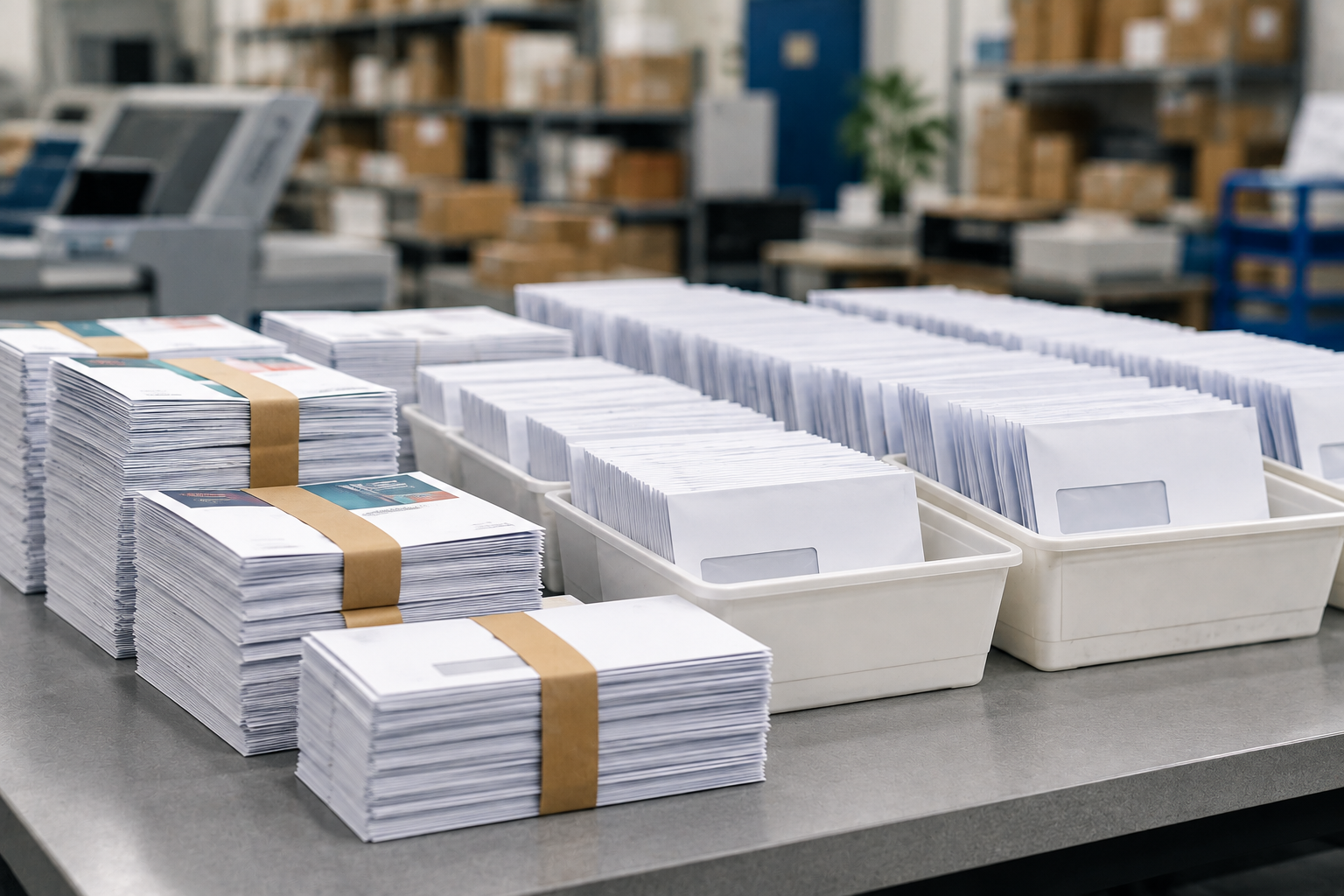
Instead of treating every letter, postcard or brochure as an individual item, larger mailings can be processed together. The mail is prepared, sorted and presented to the postal provider according to the requirements of the relevant service, helping the postal operator process the mailing more efficiently.
For businesses, the main attraction is straightforward: the more efficiently a large mailing can be processed, the lower the cost per item can potentially become.
Bulk postage is commonly used for direct mail campaigns involving letters, postcards, brochures, catalogues and other marketing communications. DMS provides bulk postage services for large-volume direct mail campaigns and works with postal providers to source cost-effective rates for its customers.
It is worth remembering that "bulk postage" isn't one single postal product. The exact requirements and pricing depend on factors including the volume of mail, format, weight, destination, level of sorting and the postal service being used.
2. How does bulk postage work?
The principle behind bulk postage is relatively simple. A business has a large mailing that needs to be delivered, and instead of processing each item individually, the mail is prepared as a single, organised mailing.
- The process starts with the mailing data and the physical mail pieces.
- Addresses need to be accurate and formatted correctly, while the finished mailers need to meet the requirements of the chosen postal service.
- The items can then be sorted and prepared before being handed over to the postal provider.
For example: imagine a business is sending 50,000 personalised postcards across the UK. Rather than treating those postcards as 50,000 completely separate pieces of mail, the campaign can be processed as one large mailing. The data can be checked, addresses standardised and the postcards sorted according to the relevant postal requirements before being presented for delivery.
DMS manages this preparation as part of its bulk postage service, including presorting and address standardisation, helping campaigns meet the requirements for available postal rates.
Want help with your direct mail campaign start to finish? We provide entire Direct mail Production Services, to make your campaign a reality.
3. Why is bulk postage cheaper?
The cost of delivering individual pieces of mail includes more than simply transporting an envelope or postcard from one address to another. Postal operators have to process, sort and distribute mail efficiently, and larger, well-prepared mailings can make that process easier to manage.
Bulk mailing discounts are designed around this principle. When a business sends a sufficiently large quantity of mail and prepares it according to the relevant requirements, the postal provider can process the mailing more efficiently. The saving can then be reflected in the postage rate!
For businesses sending thousands of pieces, even a relatively small reduction in the cost of each item can have a significant effect on the overall campaign budget.
We find that businesses using our bulk postage service can potentially save up to 25% on postage costs compared with standard rates, depending on the campaign and qualifying requirements.
Why does that matter?
Consider a campaign sending 20,000 pieces of direct mail. If the postage cost is reduced by even a small amount per item, the total saving across the campaign can become substantial. That saving can then be reinvested elsewhere, whether that's into better creative, higher-quality print, additional targeting or another marketing channel.
For this reason, postage should be considered as part of the campaign strategy from the beginning, rather than being something added onto the end once the mail has already been produced.
4. What types of mail can be sent using bulk postage?
Bulk postage isn't restricted to one particular format. The most appropriate service will depend on the size, weight, format and requirements of the mailing. Common examples include:
Letters
Personalised letters are widely used for customer communications, fundraising, financial services, membership organisations and targeted marketing campaigns.
Postcards
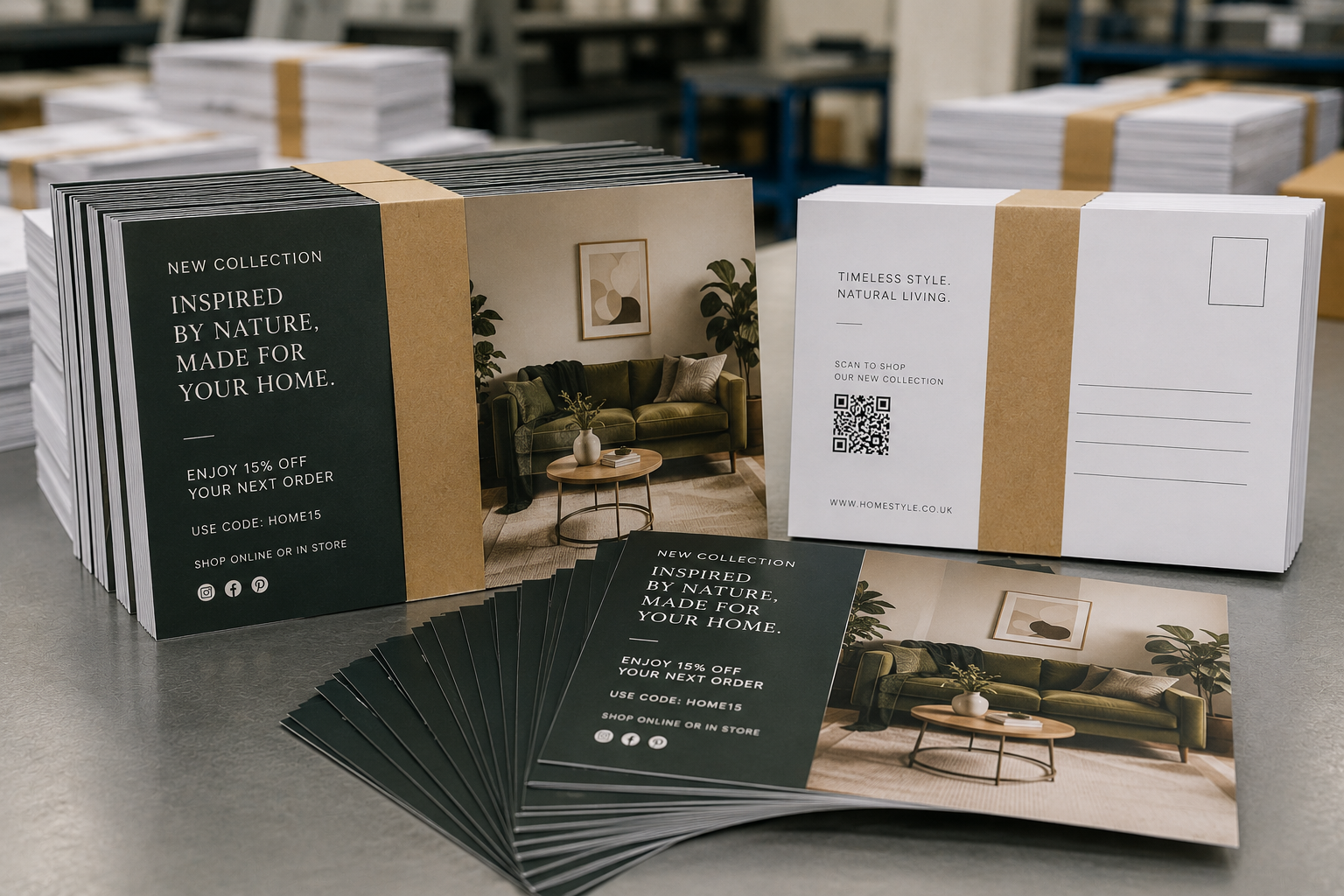
Postcards are particularly well suited to promotional campaigns because they don't require an envelope and can be processed as part of large-volume mailings.
View our full postcard marketing service here >
Brochures
Brochures provide more space for businesses that need to communicate detailed information about their products or services.
Catalogues
Retailers and other product-led businesses can use bulk postage to distribute catalogues to large customer databases.
Flyers and leaflets
Targeted promotional campaigns can use bulk postage to distribute printed promotional material to large audiences.
Mail packs
Larger campaigns can combine several elements, such as a letter, brochure, reply card and promotional insert, into a single mailing pack.
Personalised direct mail
Personalised campaigns can also be sent using bulk postage. The fact that individual mail pieces contain different names, offers or imagery doesn't prevent the overall campaign from being processed as a large mailing.
See how we can personalise your direct mail here >
The important consideration is that the finished mail piece must meet the specifications of the postal service being used.
5. How much mail do you need to qualify?
There isn't one universal volume that applies to every type of bulk postage. Minimum quantities and eligibility requirements can vary depending on the postal service, format and mailing specification.
Generally, postal providers require a minimum volume to qualify for bulk postage discounts, with the exact threshold depending on the service being used. This is why it isn't necessarily useful to think of bulk postage as simply meaning "a lot of mail". A mailing of several thousand pieces may have different options from one involving hundreds of thousands, while the format and preparation of the mail can also affect which rates are available.
If you're planning a campaign and aren't sure whether your volume qualifies, give us a call and we can discuss your campaign before production begins. They can look at the volume, format and destination and identify which postal options are likely to be most appropriate.
Talk to us about your mailing >
6. What affects the cost of bulk postage?
The volume of mail is obviously an important factor, but it isn't the only thing that determines the final postage cost. Several factors can influence which service and rate is available.
Volume
Larger mailings can potentially access more favourable rates, provided they meet the relevant requirements.
Size & format
A postcard, standard letter and large brochure don't necessarily fall into the same postal category. The dimensions of the finished mail piece can therefore affect the available options.
Weight
Heavier mailings generally cost more to send, which makes controlling the weight of each piece particularly important for large campaigns. A difference of just a few grams can become significant when multiplied across tens of thousands of mailers.
Destination
A UK-wide mailing may have different requirements from a campaign targeting a specific region, while international campaigns require different considerations altogether.
DMS offers UK and international direct mail services, as well as bulk postage and postage discounts.
Address quality
Accurate, standardised addresses help reduce delivery problems and ensure mail can be processed correctly.
Sorting
The way the mail is sorted and presented can affect which postal services and discounts are available.
Delivery requirements
If a campaign has a fixed delivery deadline, the most economical option isn't necessarily the most appropriate. Timing and service level need to be considered alongside price.
7. Sorting & presorting
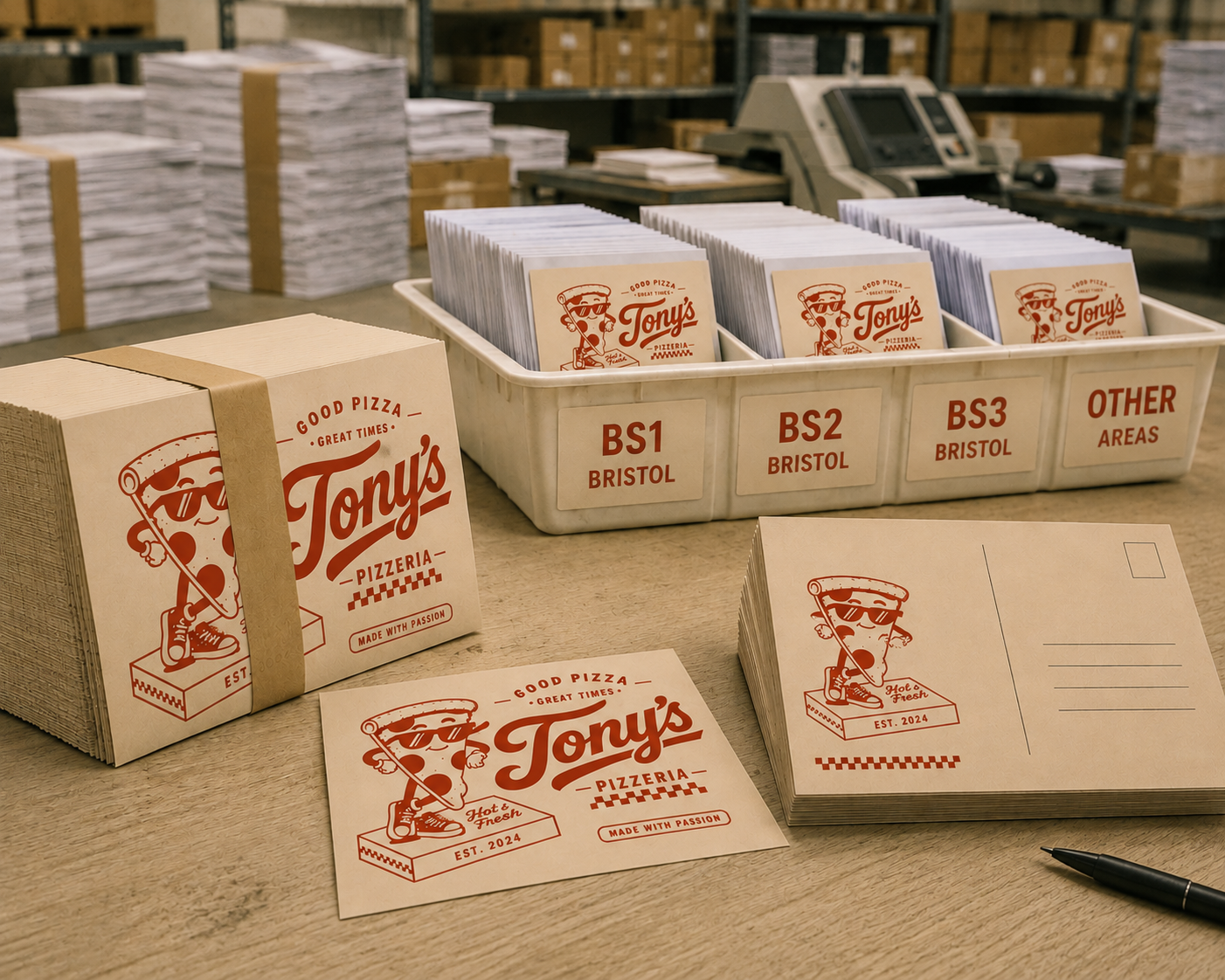
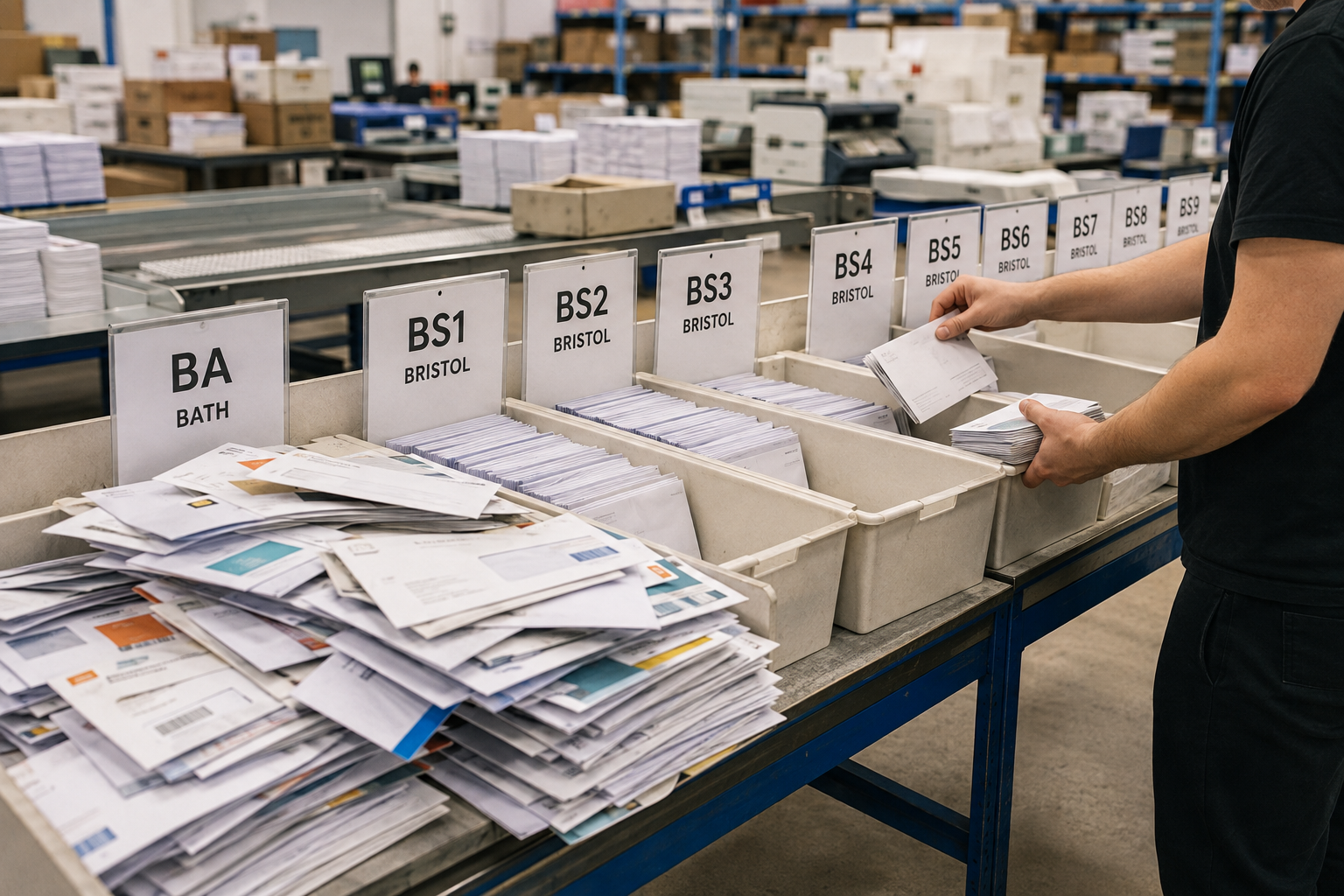
Sorting is an important part of preparing a large mailing for postage. Rather than presenting thousands of mail pieces in an unstructured pile, mail can be organised according to postal requirements. This helps the postal operator process the mailing more efficiently and can help the campaign qualify for more favourable rates.
DMS's bulk postage service includes presorting mail by postcode and carrier route, helping ensure that direct mail pieces are prepared correctly for delivery.
Why does presorting matter?
For a small mailing, sorting every individual item may not seem particularly important. At larger volumes, however, the efficiency gains can become much more significant.
A properly prepared mailing can move through the postal network more efficiently, while the business benefits from having a specialist manage the preparation rather than having to sort thousands of individual pieces itself.
This is one of the reasons mailing houses, like DMS, are particularly useful for large campaigns: the physical preparation required to obtain the best available postage rate can be handled as part of the overall fulfilment process.
8. Address standardisation & data preparation
The quality of the mailing data is just as important as the quality of the physical mail piece. An inaccurate or poorly formatted address can cause a number of problems. The item may be delayed, returned to sender or become more difficult to process, while sending mail to incorrect or duplicated addresses also creates unnecessary costs.
Address standardisation involves checking and formatting address information so that it is suitable for mailing and meets the requirements of the relevant postal service.
We provide data processing and address standardisation as part of our bulk postage services, helping ensure that mailing data is accurate and suitable for postal preparation.
This can be particularly important for large databases. If you're sending 100,000 pieces of mail, even a small percentage of inaccurate or duplicate records could result in thousands of wasted mailers. Good data preparation therefore isn't just about achieving a better postage rate. It can also reduce waste and improve the overall efficiency of the campaign.
9. Postal discounts & mailing services
There are different postal services and discount structures available for businesses sending direct mail in volume. The most suitable option will depend on the characteristics of the campaign.
DMS has access to a range of Royal Mail and Down Stream Access products and can advise on the most cost-effective distribution method for a particular mailing. Its postal services include UK postage, international postage, bulk postage and parcels and packets postage.
The important thing is not to assume that the cheapest-looking postage option will always be the best choice. A mailing needs to be considered as a whole, taking into account volume, format, weight, destination, preparation requirements and the delivery timescale. A specialist mailing house can assess these factors together and determine which route makes the most sense for the campaign.
View our Postal Discount Services →
10. Preparing your direct mail for postage
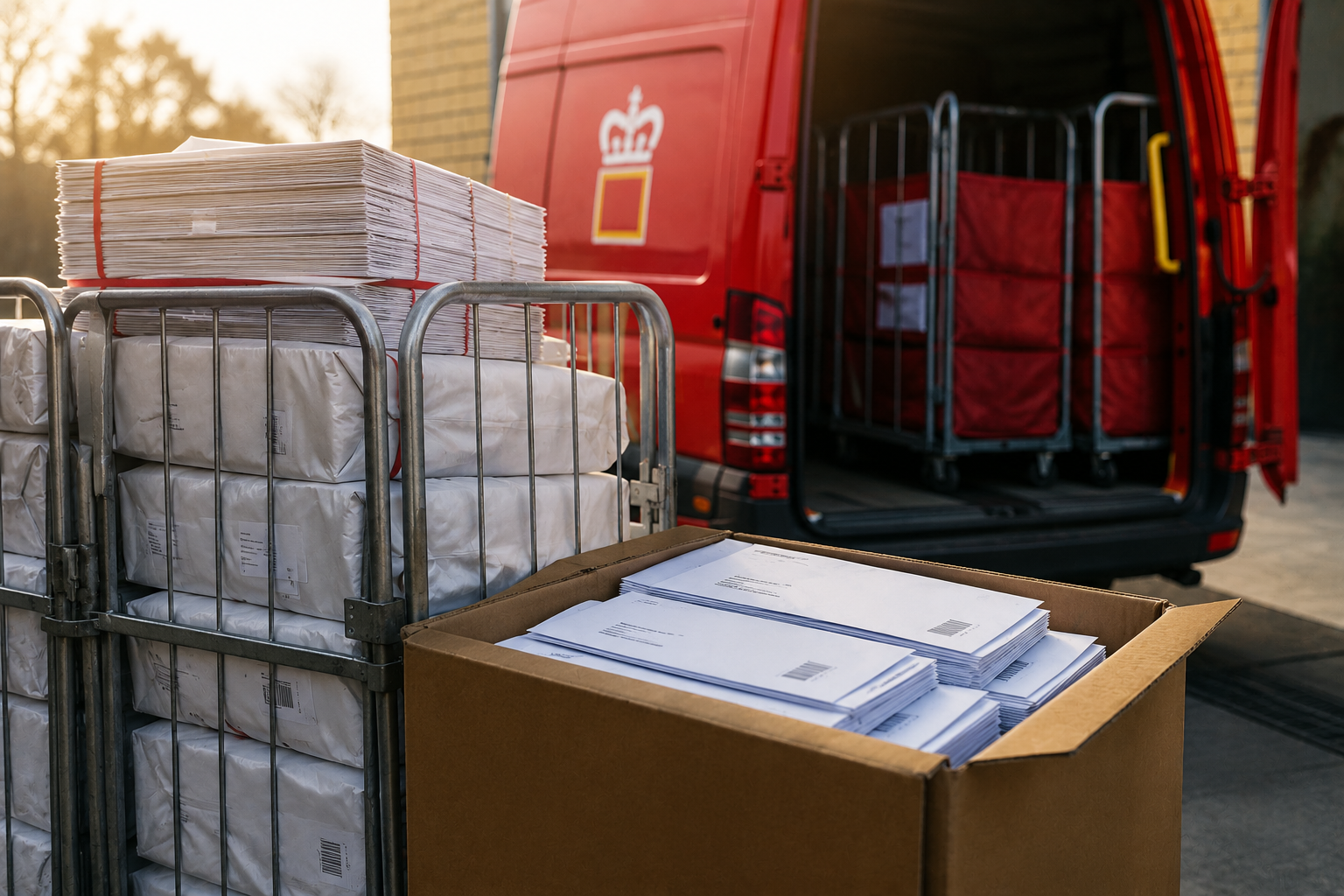
Postage shouldn't be considered separately from the design and production of the campaign. This is because the physical format of your mailer can influence how it is processed and, consequently, the postage options available. This means it's worth considering postage requirements before artwork is finalised.
For example, think about:
- The finished dimensions
- Paper stock
- Overall weight
- Whether the item needs an envelope
- Whether inserts are being included
- Whether the mailer is personalised
- Whether a sample or promotional item is attached
- How the finished item will be sealed
- How it will be addressed
A heavier mailer containing several inserts may require a different postage solution from a simple postcard. Likewise, a campaign involving personalised letters, envelopes and multiple inserts may require enclosing and fulfilment before it can be sorted and presented for postage.
This is why involving the postage provider or mailing house early in the process can be beneficial. Changes made during planning are generally much easier than trying to redesign or reconfigure a campaign once everything has already been printed.
11. Bulk postage vs standard postage
So, when should a business consider bulk postage rather than simply paying standard postage rates? The biggest difference is the scale and preparation of the mailing.
With standard postage: individual items can be processed through the postal network without the same level of bulk preparation. This can make sense for smaller or occasional mailings where the administrative effort of preparing the campaign for a bulk service isn't justified.
With bulk postage: a larger mailing is prepared collectively. Data is checked, addresses are standardised, mail is sorted and the campaign is presented according to the requirements of the chosen postal service.
Standard postage
Best suited to smaller or less complex mailings where volume discounts aren't a major consideration.
Bulk postage
Best suited to larger campaigns where reducing the cost per item can make a meaningful difference to the overall campaign budget.
The important point is that bulk postage isn't necessarily about sending the biggest possible mailing. It's about preparing a mailing efficiently enough that the available postal discounts make financial sense.
12. How does the bulk postage process work?
Working with a mailing house like DMS can take much of the complexity out of organising a large postal campaign.
Step 1: Plan the campaign
Start with the number of mail pieces you need to send, your target audience, the format of the mailer and your desired delivery timescale.
Step 2: Prepare your data
Your mailing database is checked and prepared, including address standardisation and any segmentation or personalisation required.
Step 3: Produce the mail
The letters, postcards, brochures, catalogues or other mail pieces are printed and prepared.
Step 4: Complete fulfilment
If the campaign includes envelopes, inserts, samples or additional components, these are assembled into the finished mailing.
View our specialist fulfilment services >
Step 5: Sort the mail
The completed mail pieces are sorted according to the requirements of the chosen postal service.
Step 6: Select the appropriate postage service
The campaign is assessed to identify the most cost-effective available postage option.
Step 7: Dispatch
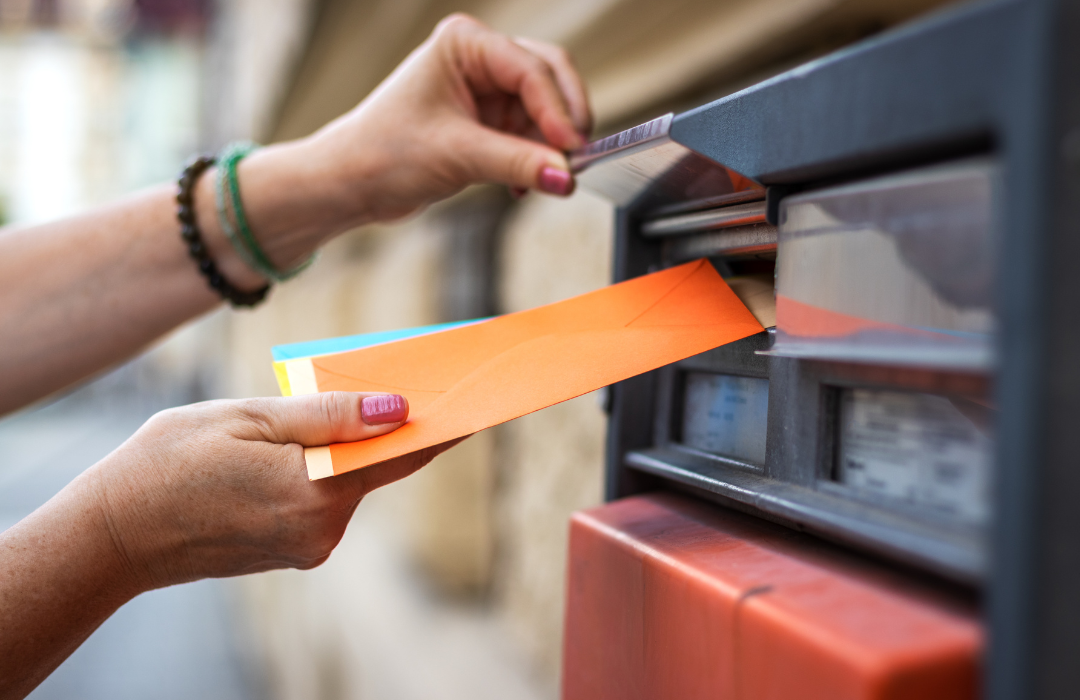
The prepared mailing is handed over to the relevant postal provider for delivery.
Step 8: Measure the campaign
Once the campaign has been delivered, response and conversion data can be analysed to understand its performance and calculate the overall return on investment.
The advantage of using a mailing house is that these stages don't have to be managed independently. DMS can support campaigns across data processing, printing, production and postage, creating a more streamlined end-to-end process.
13. Why use DMS for bulk postage?
Managing a large mailing internally can quickly become complicated. There is the data to prepare, the mail to print, items to sort and the postage service to organise, all while making sure the campaign meets the relevant requirements.
DMS has been providing mailing and fulfilment services since 1974 and operates from a 12,000 sq ft mailing house facility in Bristol. The company provides printing, enclosing, wrapping, data processing and postage services, allowing businesses to manage multiple stages of their campaigns through one supplier.
For bulk postage specifically, DMS works with postal providers including Royal Mail to access postage discounts and manages processes including presorting, address standardisation and the associated logistics and paperwork. This means the focus isn't simply on finding a low postage price. The aim is to look at the whole mailing and identify the most cost-effective way of getting it produced, prepared and delivered.
For a business sending large volumes of direct mail, that can make the process considerably simpler while helping to control the overall campaign cost.
14. How to reduce the cost of your bulk mailing
Postage is only one part of the cost equation. The most effective way to reduce the overall cost of a large mailing is to consider the campaign as a whole.
Plan the postage early
Don't wait until your mail has been designed and printed before looking at postage. The format, weight and construction of the mailer can all influence the available options.
Get your data right
Accurate addresses reduce the risk of returned or undeliverable mail and help ensure the campaign meets postal requirements.
Consider the weight
If you're sending tens of thousands of pieces, small differences in weight can have a noticeable impact on the total cost. Review your paper stock, inserts and packaging before production.
Choose the right format
A simple postcard may have very different postage implications from a multi-page brochure enclosed in a large envelope. Choose the format based on what the campaign needs to achieve rather than adding unnecessary components.
Take advantage of volume
If you are already planning several separate mailings, consider whether combining or coordinating campaigns could create efficiencies. The right approach will depend on your campaign objectives and delivery requirements.
Use a mailing house
A specialist mailing house can handle the data preparation, sorting, production and postage requirements on your behalf, while using its postal relationships and expertise to identify the most appropriate options.
At DMS, our bulk postage service can help businesses reduce postage costs and improve campaign ROI, with discounts dependent on the volume and requirements of the mailing.
15. Bulk postage for different types of campaigns
Bulk postage can be used across a wide range of industries and campaign types.
Retail campaigns
Retailers can send catalogues, promotional postcards, seasonal offers and personalised customer communications to large databases.
See how we help retailers with their direct mail campaigns >
Charity campaigns
Charities often need to communicate with large supporter databases, making efficient postage particularly important when campaigns involve significant volumes.
See how we help charities with their direct mail campaigns >
Property campaigns
Estate agents, property developers and other property businesses can use large-scale mailings to target specific geographic areas.
See how we help property companies with their direct mail campaigns >
Local businesses
Businesses with multiple locations can use targeted mail campaigns to reach households within specific areas.
B2B campaigns
Companies can use bulk postage to distribute brochures, sales literature, event invitations and other communications to business audiences.
Sampling campaigns
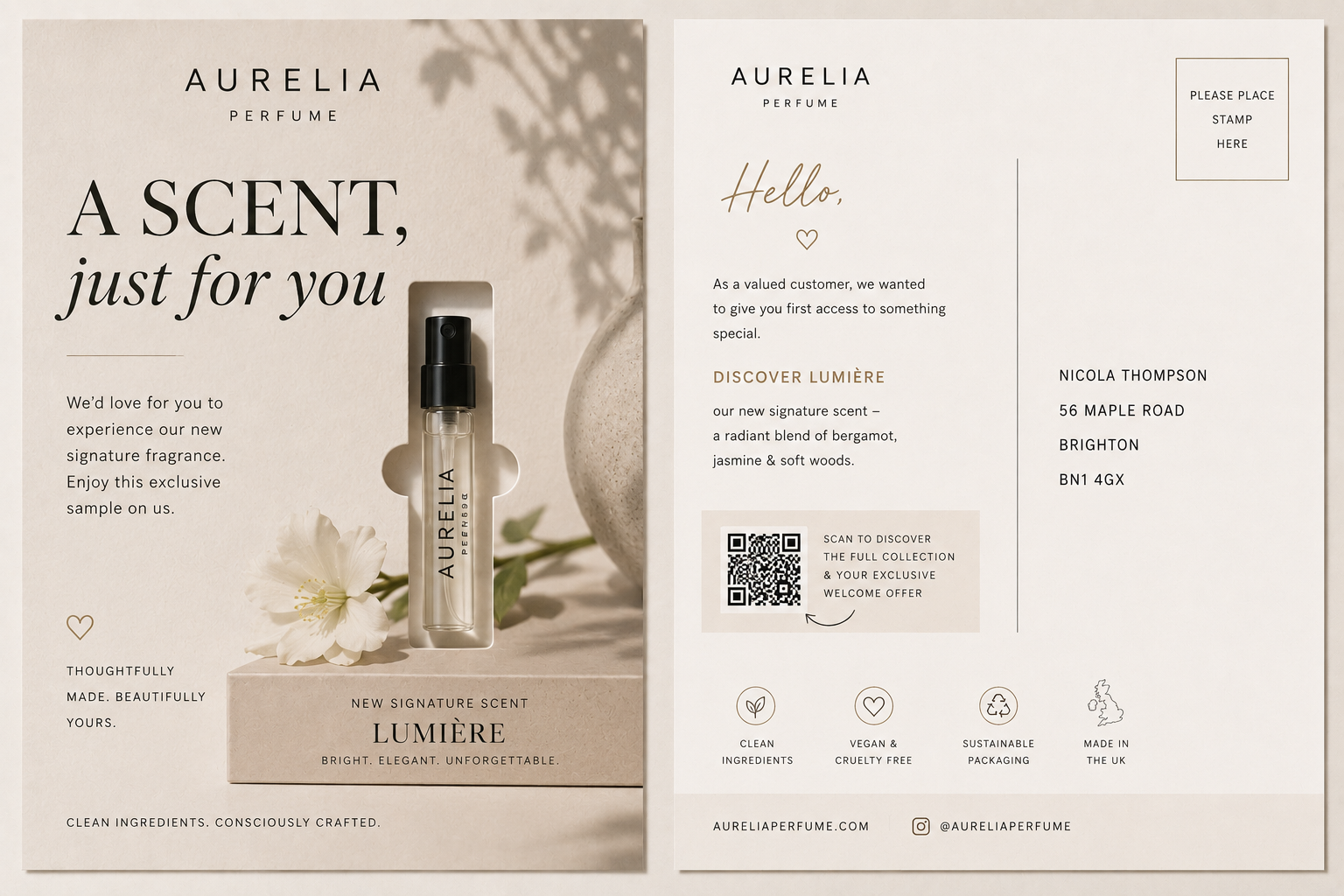
Mailings containing product samples or promotional materials can also be produced and distributed at scale, although the additional weight and dimensions need to be considered when selecting the postage solution.
View all our direct mail sampling services >
16. Common bulk postage mistakes to avoid
Leaving postage until the end
One of the most common mistakes is treating postage as the final stage of the campaign. By that point, the format and weight may already be fixed, limiting the options available. Instead, consider postage alongside design, print and production from the beginning.
Ignoring the weight of the mailer
A small increase in the weight of every individual piece can become significant when multiplied across a large mailing. Consider paper, inserts, envelopes and any additional components together.
Using inaccurate addresses
Poor-quality data can result in returned mail and wasted postage. Address checking and standardisation should form part of the preparation process.
Assuming more volume automatically means a better rate
Volume is important, but postal discounts depend on meeting the requirements of the particular service. A large mailing still needs to be prepared correctly.
Failing to allow enough preparation time
Sorting, data processing and production all take time. If the campaign has a fixed delivery date, build sufficient time into the schedule.
Trying to manage everything internally
For smaller mailings, managing postage internally may be perfectly practical. As volume increases, however, the administrative and physical work involved can quickly become disproportionate.
A mailing house can take responsibility for much of this process, allowing the marketing team to focus on the campaign itself.
17. Bulk postage checklist
Before sending a large direct mail campaign, use this checklist to make sure you've considered the key requirements.
Campaign planning
☐ Define the campaign objective
☐ Confirm the target audience
☐ Establish the mailing quantity
☐ Set the required delivery timeframe
☐ Decide on the format of the mailer
Design and production
☐ Confirm dimensions
☐ Select paper stock
☐ Calculate finished weight
☐ Consider envelopes and inserts
☐ Consider samples or additional components
☐ Confirm whether personalisation is required
Data
☐ Clean the mailing database
☐ Remove duplicates
☐ Standardise addresses
☐ Check postcode information
☐ Confirm the final mailing quantity
Postage
☐ Check minimum volume requirements
☐ Identify appropriate postal services
☐ Compare available rates
☐ Confirm sorting requirements
☐ Confirm addressing requirements
☐ Allow sufficient preparation time
Dispatch
☐ Complete final quality checks
☐ Sort and prepare the mailing
☐ Confirm handover arrangements
☐ Confirm expected delivery times
Measurement
☐ Include response tracking where appropriate
☐ Use unique promotional codes if relevant
☐ Track QR codes or URLs
☐ Monitor responses and conversions
☐ Calculate campaign ROI
Frequently Asked Questions
How much mail do I need to qualify for bulk postage?
There isn't one universal minimum volume because requirements vary depending on the postal service and mailing specification. We advises customers to discuss their campaign with the team to determine which services and minimum quantities apply.
How much can I save with bulk postage?
The saving depends on the volume, format, preparation and postal service being used. Most businesses can potentially save up to 25% compared with standard postage rates on qualifying bulk mailings.
What types of mail can be sent using bulk postage?
Bulk postage can be used for many types of direct mail, including letters, postcards, brochures, catalogues, flyers and other marketing communications.
Does bulk postage take longer to arrive?
Bulk mail is prepared and sorted in advance, which can support efficient processing and delivery. However, the actual delivery timeframe depends on the postal service selected and the requirements of the individual campaign.
Do I need to sort my own mail?
Not necessarily. We handle presorting as part of its bulk postage service, including sorting mail by postcode and carrier route to help campaigns meet postal requirements.
Does my mailing data need to be cleaned first?
It is strongly recommended. Accurate, standardised addresses help reduce delivery problems and can help ensure that the mailing meets the requirements of the chosen postal service. DMS can handle data processing and address standardisation as part of its service.
Can personalised mail be sent using bulk postage?
Yes. Personalised mail can still be processed as a bulk campaign. Variable elements such as names, offers, imagery and QR codes can be produced at scale using digital and variable data printing.
Can I send postcards using bulk postage?
Yes. Postcards are one of the formats that can be used for bulk direct mail campaigns, provided the mailing meets the requirements of the selected postal service.
Can DMS handle the printing as well as the postage?
Yes. DMS offers printing, direct mail production, data processing and postage services, allowing the different stages of a campaign to be managed together.
Can DMS handle international bulk mail?
DMS also provides international postage services and can use Royal Mail and Down Stream Access to support international campaigns.
Make your next bulk mailing more cost-effective
For large direct mail campaigns, postage can have a significant impact on the overall marketing budget. Taking the time to plan the mailing properly, prepare accurate data, choose an appropriate format and access the right postal service can help reduce unnecessary costs while ensuring your campaign reaches its intended audience efficiently.
The process doesn't need to be managed in isolation. From data processing and printing through to sorting, postage and delivery, working with an experienced mailing house can bring the different stages together and make large-scale campaigns easier to manage.
Direct Mail Systems can support businesses with the preparation and delivery of bulk mailings, using its experience, postal relationships and in-house mailing capabilities to identify cost-effective solutions for each campaign.